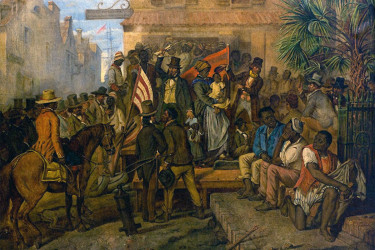
A sale of enslaved people in Charleston, South Carolina, 1854.
partner

How the Slave Trade Built Charleston

The city's prosperity grew from a system that trafficked human beings and turned their lives into profit.
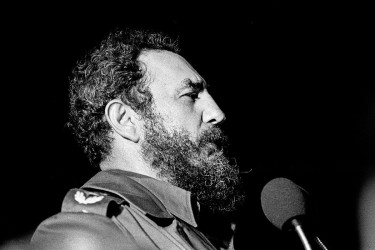
Fidel Castro.
partner

Inventing “Machismo” in the US

Academics and media turned “machismo” into a cultural stereotype during the Cold War.
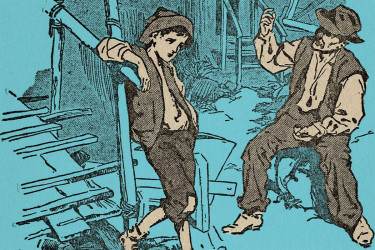
Illustration of a man scolding a pouting urban youth.
partner

Worried About Teens Today? So Were Adults in the 1920s

A century ago, new technology and mobility reshaped what it meant to be young, linking rural life more closely to the city.
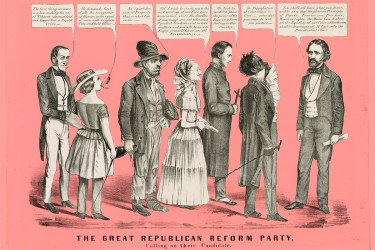
1856 Republican candidate John C. Frémont is portrayed as the champion of a motley array of radicals and reformers. via Wikimedia Commons
partner

The Revolutionary Beginnings of the Republican Party

Popular resistance to the Fugitive Slave Law and “Slave Power” helped forge a new electoral force.
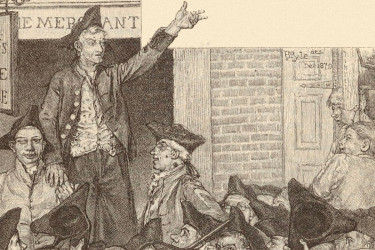
Isaac Sears addressing the mob.
partner

When Profit Met Protest in Colonial New York

Economic self-interest shaped how New Yorkers responded to British taxes and imperial crackdowns.
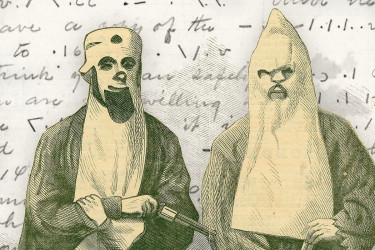
Men wearing Klan hoods, and a manuscript with a coded message.
partner

A Secret Cipher for the KKK

How did the Ku Klux Klan spread across the South? Part of its journey depended on a code for secret correspondence.
Sunday Morning in front of the Arch Street Meeting House, Philadelphia, 1811
partner

Quakers Against Thanksgiving

In colonial America, government “thanksgivings” blurred faith and politics. For Quakers, rejecting them was an act of religious conviction.
A working class white family with ten children.
partner

Defining “White Trash”

The term “white trash” once was used to disparage poor white people. In the Civil Rights era, its meaning shifted to support business-friendly racial politics.
Alexander Hamilton painting by John Trumbul, 1792.
partner

Hamilton’s Real Immigration Story

The popular musical poses Alexander Hamilton as a symbol of the value of immigrants brought to America, but over time, his party became increasingly xenophobic.
The logo for Canada Lumber.
partner

French Canadians in the New England Woods

French Canadians held a distinct position in an American labor landscape in which experts viewed different “races” as being suited to different kinds of work.
Two women smiling together.
partner

Lesbians and the Lavender Scare

Lesbian relationships among government workers were seen as a threat to national security in the 1950s. But what was a lesbian relationship?
Painting imagining Washington shaking hands with Lincoln in front of liberty's flame.
partner

Praising Washington in Lincoln’s Day

At the time of the Civil War, many Americans revered the nation’s Founding Fathers, and both supporters and opponents of slavery recruited them to their sides.
A gay couple and their children at a rally in California in 2004.
partner

“Protecting Kids” from Gay Marriage

Leading up to a 2004 debate about same-sex marriage, conservatives shifted their focus away from moral issues and toward arguments about children’s welfare.
A large mob in Louisiana breaking down prison doors to lynch Italian immigrants.
partner

Attacking Italians in Louisiana

Italian immigrants had no qualms about working and living alongside Black Americans, which made them targets for violence by white vigilantes in Louisiana.
Two images: Lajpat Rai (left) and W.E.B. Du Bois (right).
partner

Black Freedom and Indian Independence

Activists including W. E .B. Du Bois in the United States and Lajpat Rai in India drew connections between Black American and Indian experiences of white rule.
Illustration of the Georgia Peach.
partner

The Georgia Peach: A Labor History

The peach industry represented a new, scientifically driven economy for Georgia, but it also depended on the rhythms and racial stereotypes of cotton farming.
Two people calling on AT&T PicturePhone.
partner

A Prehistory of Zoom

Concerns about privacy and pressures regarding the physical appearance of women and their homes contributed to the failure of AT&T’s 1960s Picturephone.
An 1890s advertising poster for Coca Cola featuring a well-to-do white woman.
partner

Who Took the Cocaine Out of Coca-Cola?

The medical profession saw nothing wrong with offering a cocaine-laced cola to white, middle-class consumers. Selling it to Black Americans was another matter.
Star-Herb Medicines and Teas for all Diseases, 1923.
partner

How Government Helped Birth the Advertising Industry

Advertising went from being an embarrassing activity to a legitimate part of every company’s business plans—despite scant evidence that it worked.
The 19-year-old Indian elephant, Fritz-Frederic, favorite of the children of Paris, was put to death after he had gone mad for several days, c. 1910.
partner

Elephant Executions

At the height of circus animal acts in the late nineteenth century, animals who killed their captors might be publicly executed for their “crimes.”
Map of New York state from 1813
partner

Suppressing the Black Vote in 1811

As more Black men gained the right to vote in New York, the state began to change its laws to reduce their power or disenfranchise them completely.
Living history interpreter demonstrating a mortar and pestle in a historic kitchen.
partner

The Countercultural History of Living Museums

In the 1960s and ’70s, guides began wearing period costumes and farming with historical techniques, a change that coincided with the back-to-the-land movement.
A poster of a colonial man ringing a bell in front of Independence Hall with the words "4 Minute Men" at the top
partner

The US Propaganda Machine of World War I

As the United States prepared to enter World War I, the government created the first modern state propaganda office, the Committee on Public Information.
People scavenging through garbage on a barge in New York City
partner

A History of Garbage

The history of garbage dumps is the history of America.