Collection

Revolutionary Motivations

The phrase “the causes of the American Revolution” conjures up a familiar litany of acts of Parliament, impassioned declarations by idealistic elites, and a series of escalatingly violent standoffs, trundling along a path toward seemingly inevitable war. But as historian Helena Yoo Roth notes in a critique of Ken Burns’s latest documentary, “we rarely find meaning in lists of events. Meaning comes from understanding what those events signified for the people who lived them and for the world they left in their wake.”

The articles below explore how a range of colonists, from frontier farmers to devout evangelicals, from young lovers in Boston to a privateer-turned-investor in New York, faced a rapidly changing society. You’ll also find a new exhibit highlighting the issues that shaped political and economic struggles in British North America — issues deemed so important that colonists took up arms to wage what became the American Revolution.

This collection was featured in Continuum, the joint newsletter of Bunk and HNN, on March 19, 2026: https://tinyurl.com/Continuum3-19-26
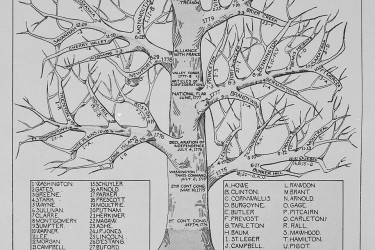
A chart of battles, leaders, and congresses during the Revolutionary War, 1931-1932.

Ken Burns's Inevitable Revolution

Burns in his new documentary failed to ask the most important question: "Why?"
To understand the “why” questions of the American Revolution, it is crucial to foreground people’s agency and to grapple with contingency.
Join, or Die political cartoon by Benjamin Franklin

The Slow Build Up to the American Revolution

American revolutionaries had a far wider range of reasons for supporting rebellion than we often assume.
The beliefs that animated common folks’ support for revolution are evident in town meeting records, newspapers, and sermons on “the character of just wars,” and “the moral obligation to resist tyranny.”
The first Congress in prayer.

The Bible in Revolutionary America

While Enlightenment philosophy may have influenced the wealthy Revolutionary elites, it was the Biblical worldview that prompted widespread resistance.
The Bible-reading Protestant view of human nature, influenced by the Great Awakening, made folks suspicious of government and vigilant about preserving their own rights and autonomy.
Left: cover of "The New Yorkers," a book by Sam Roberts, featuring a collage of black and white photographs of different people. Right: 1884 illustration of British soldiers in long coats fighting with New York men
partner

Isaac Sears and the Roots of America in New York

Like so many other reluctant revolutionaries in New York, he seemed the antithesis of the rabble in arms that the British identified with the mobocracy.
One of the “reluctant revolutionaries” among New York City’s elites, a former privateer turned wealthy West Indies investor led an armed takeover of City Hall and the Customs House.
Woodcut depicting British soldiers shooting at colonists in the Boston Massacre.

Gossip, Sex, and Redcoats: On the Build-Up to the Boston Massacre

Don't let anyone tell you revolutionary history is boring.
After a Boston patriot found his granddaughter in bed with a British soldier, the Sons of Liberty turned the affair into a propaganda tool against military occupation.