Collection

1619 and its Discontents

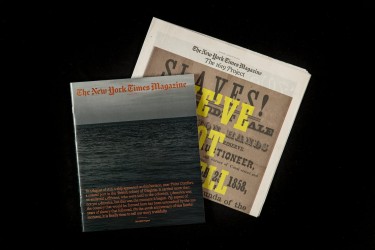
To mark the 400th anniversary of the arrival of “20 and odd” enslaved Africans in the British colony of Virginia, the New York Times Magazine published a special edition in August 2019, consisting of 18 articles and a number of short essays about the legacies of slavery. Ever since, The 1619 Project's claims have fueled intense debate about how Americans should teach, think, and write about their past. This collection represents the twists and turns of that debate.

Preaching a Conspiracy Theory

The 1619 Project offers bitterness, fragility, and intellectual corruption—not history.
Historian Allen Guelzo was an early critic. Here, he argues that the project "is not history: it is polemic, born in the imaginations of those whose primary target is capitalism itself and who hope to tarnish capitalism by associating it with slavery."
Slave shackles.

The Hidden Stakes of the 1619 Controversy

Critics of the New York Times’s 1619 Project obscure a longstanding debate among historians over whether the American Revolution was a proslavery revolt.
Much of the debate about the 1619 Project centered on the role of slavery in the American Revolution. Here, historian David Waldstreicher offers some background for that debate.

1619 and All That

The Editor of the American Historical Review weighs in on recent historiographical debates around the New York Times' 1619 Project.
Historian Alex Lichtenstein takes issue with the way some of his fellow historians took issue with the 1619 Project. "[S]ingling out errors in one essay does not suffice to dismiss the project in its entirety."

Sorry, New York Times, But America Began in 1776

The United States didn't begin in 1619.
One of the scholars associated with "1776 Unites" explains what he describes as "a non-partisan black-led response to the New York Times’s 1619 Project."

I Helped Fact-Check the 1619 Project. The Times Ignored Me.

The paper’s series on slavery made avoidable mistakes. But the attacks from its critics are much more dangerous.
Both the 1619 Project and its prominent critics were guilty of oversimplification, according to historian Leslie Harris. Here, she lays out a more complex picture of the American Revolution that has emerged from recent scholarship.

History As End

1619, 1776, and the politics of the past.
Historian Matt Karp offers a critique of the project from the left, taking issue with its "origin-obsessed" history. "How can a history grounded in continuity," he writes, "relate to a politics that demands transformational change?"
Photo illustration of two hands pulling New York Times Magazine article

The Historians Are Fighting

Inside the profession, the battle over the 1619 Project continues.
The project's central claim about the American Revolution was the subject of a public debate between historians Gordon Wood and Woody Holton. Historian William Hogeland gives a blow-by-blow.
Cracked wall.

The Danger of a Single Origin Story

The 1619 Project and contested foundings.
A high-school history teacher cautions against an emphasis on origins, and explains what's wrong with pitting 1619 against 1776 as the date of the nation's "true founding."
Left: stacks of The 1619 Project books; right: Daryl Michael Scott.

Grievance History

Historian Daryl Scott weighs in on the 1619 Project and the "possibility that we rend ourselves on the question of race."
Historian Daryl Scott worries that the 1619 Project could be a step backward for the teaching of history, arguing that it
"doesn’t talk about Black people so much as it talks about what white people did to Black people."