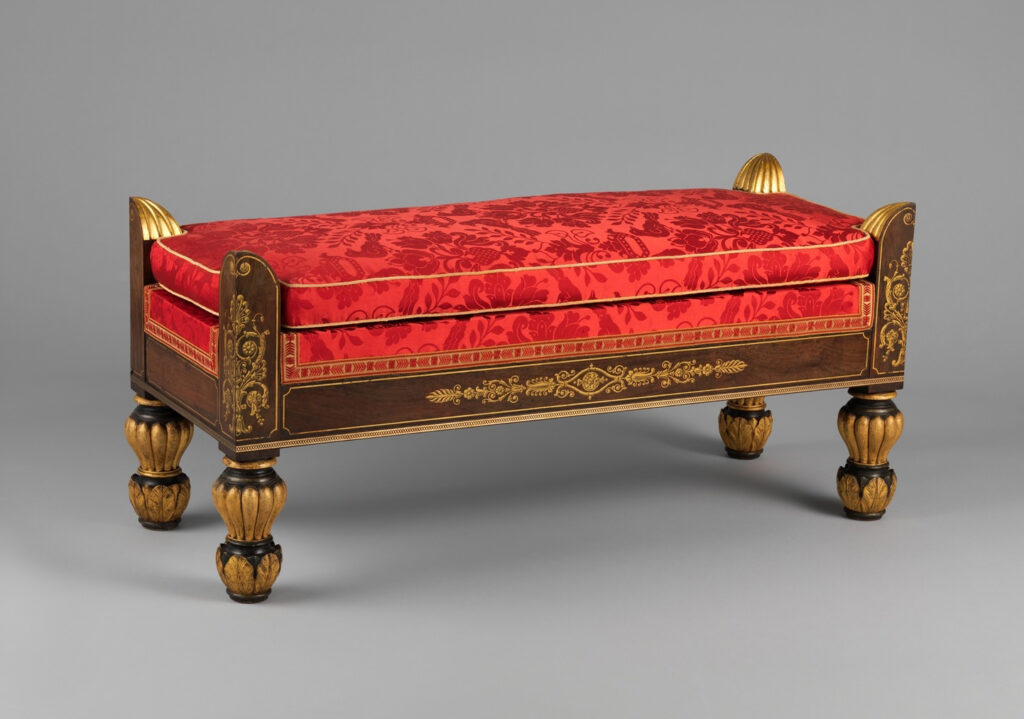
 17 inches. Made as part of a commission from banker Robert Donaldson Jr. (1800–1872), the window seats are again at Edgewater, his home overlooking the Hudson River in Barrytown, New York, now owned by the Richard Hampton Jenrette Foundation. Collection of the Richard Hampton Jenrette Foundation.
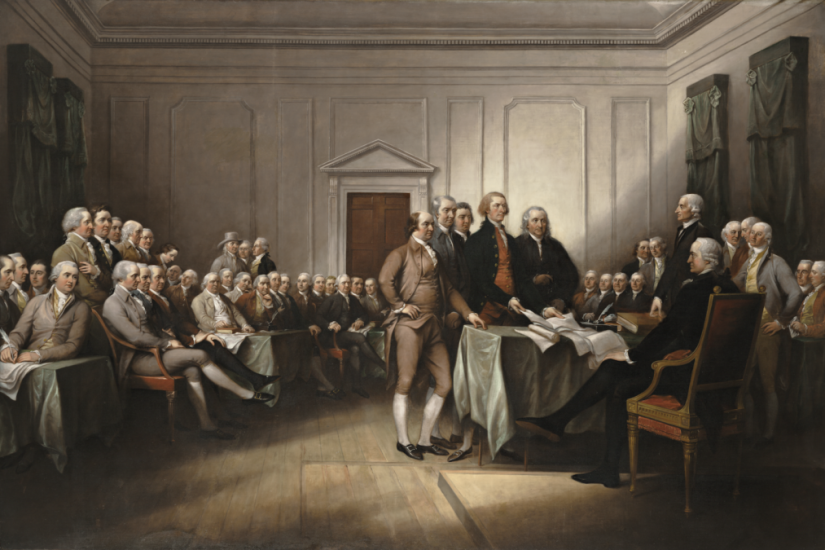
By 1826 the annual rite of celebrating the Fourth of July was already a well-established tradition, one that encouraged Americans to look to both the past and the future. In 1824, the nation had enthusiastically welcomed the return of the Marquis de Lafayette, the heroic French ally of George Washington during the Revolutionary War. A patriotic mindset had also led Congress, in 1817, to commission the famed painter John Trumbull to re-create a massive twelve-by-eighteen-foot version of his Declaration of Independence, one of a series of four history paintings to be placed in the Rotunda of the United States Capitol. His original version, only twenty-one by thirty-one inches, was begun in 1786 but not fully completed until thirty years later because of his desire to record the proper likenesses of the participants. In preparing the composition, which to this day is presumed to depict the actual signing of the Declaration, Trumbull initially gathered as much factual information as he could, even going so far as to interview Thomas Jefferson in Paris in 1786 about his recollections of the historic event.
Nevertheless, the artist did take historical and artistic liberties. As historian Emily Sneff has documented, the Committee of Five—John Adams of Massachusetts, Benjamin Franklin of Pennsylvania, Thomas Jefferson of Virginia, Robert R. Livingston of New York, and Roger Sherman of Connecticut— is shown in front of the main table presenting the Declaration of Independence to John Hancock, in his capacity as president of the Continental Congress. In fact, this event occurred on the twenty-eighth of June, and did not include Franklin or Livingston, who was an unwavering opponent of the Declaration. The document was formally adopted on July fourth, but not actually signed by most members until after August second. In short, the gathering as painted by Trumbull, quickly embedded into the national consciousness, never actually took place, at least not as shown. The painter exercised similar artistic license in his depiction of the room itself, showing a classically inspired space that features a monumental ornamental trophy on the rear wall. Trumbull also added elaborate neoclassical chairs of the sort he would have seen in Europe in the early 1780s instead of the more modest seating, likely Windsor chairs, that occupied the Assembly Room. Perhaps in response to subsequent criticism regarding the inaccuracies in his original painting, he composed a more architecturally accurate version in 1832 (now in the collection of the Wadsworth Atheneum Museum of Art).