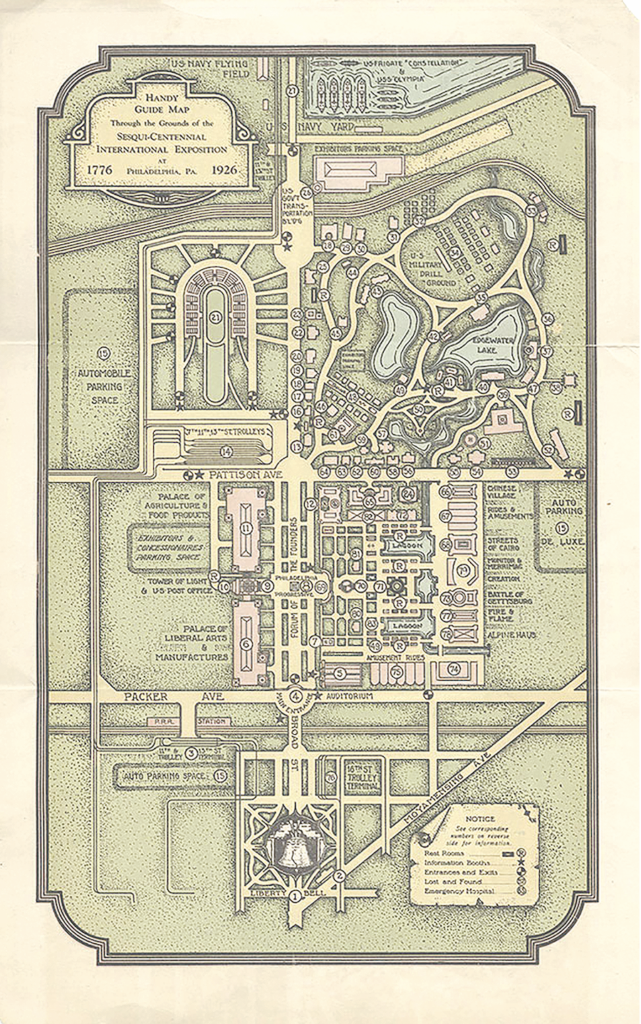
The official national celebration of the 150th anniversary of the Declaration of Independence nearly didn’t happen. Despite a decade of advocacy from business and political leaders in Philadelphia—who saw the city as the natural home for a world’s fair to commemorate the country’s Sesquicentennial, as both a key birthplace of the American republic and the prior host of the Centennial Exhibition in 1876—the planning and execution of the Sesquicentennial International Exposition was a turbulent process of false starts, delayed decisions, and conflict within the city’s political and philanthropic communities. Federal support was slow to materialize; Congress did not approve funds for the Sesquicentennial until February of 1925, and uncertainty about cash flow required scaling back the fair’s scope multiple times. Even when it was opened on May 31, 1926 (supposedly “ahead of schedule,” though large portions of the grounds and exhibits were still incomplete), long stretches of bad weather resulted in uneven attendance. The exposition ultimately saw just a fraction of its projected forty to fifty million visitors.
In its rocky path to realization, the Sesquicentennial mirrored the many contradictions of the 1920s United States. A humming economy and flourishing urban artistic communities sat uneasily alongside entrenched political machines, racial segregation, and rural poverty. The reach of film and radio connected more people than ever before, while strident anti-immigrant discourses divided them. The “Machine Age” seemed to offer a future of prosperity and convenience, even as industrial workers saw their working conditions deteriorate and their labor rights erode. Hints of these contradictions come through in a poster for the exposition, showing an allegorical America—complete with Phrygian cap denoting liberty and equality—standing above the engineering marvel of the Delaware River Bridge (today the Benjamin Franklin Bridge, completed in 1926 and dedicated as part of the Sesquicentennial celebration). The fictive classicizing cityscape is caught between historicism and modernity. The poster announces “America Welcomes the World”—but it was a provisional welcome only, as the immigration restrictions of the 1921 Emergency Quota Act and 1924 Asian Exclusion Act had made clear.