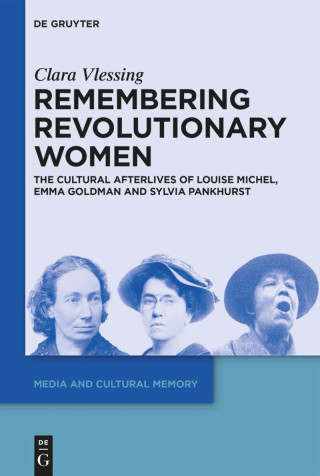
Historic anarchists Louise Michel (b. France 1830, d. France 1905) and Emma Goldman (b. Russian Empire 1869, d. Canada 1940) continue, a hundred years on from the heyday of their revolutionary activity, to pop up in unexpected places.
We can’t know whether Emma Goldman would have enjoyed Sophie Ellis-Bextor’s 00s pop song ‘If I can’t dance…’, but it seems unlikely. Ellis-Bextor transforms a phrase that is often attributed to Goldman, ‘if I can’t dance, I don’t want to be part of your revolution’, into a catchy confection of synths, sultry vocals and leggy dance routines. The song’s association with the turn-of-the-century revolutionary, described by J. Edgar Hoover as one of the most dangerous anarchists in America, is unexpected, out of character, even inappropriate.
All the same, the movement of this quotation, or misquotation, from a passage in Goldman’s autobiography, through its appearance on activist merchandise in the 1970s and into Ellis-Bextor’s glitterball world, demonstrates the staying power of this radical figure – not to mention the ways in which she is transformed from a committed militant, viewed by the public as violent and lawless, into an all-purpose party girl.
Goldman lives on because of the hard work of later activists who found inspiration in her actions and solace in her words, often representing her as a foremother of radical feminism. After her initial engagement with anarchism in the hotbed of New York’s immigrant communities in the 1880s and 90s, Goldman unwaveringly pursued what she called, ‘[t]he philosophy of a new social order based on liberty unrestricted by man-made law; the theory that all forms of government rest on violence, and are therefore wrong and harmful, as well as unnecessary’.
Her political activity involved organising strikes and rallies, pamphleting, petitioning and, in a particularly dramatic incident, she co-organised an (unsuccessful) assassination attempt on a wealthy oil magnate. She frequently found herself in prison. At the lectern Goldman was a tour de force, packing out lecture halls on both sides of the Atlantic with talks on the twinned evils of militarism and capitalism and topics ranging from access to birth control to modern theatre, the virtues of free love, the value of education and the transformative power of art.
Yet when Goldman died in 1940, it was in relative obscurity. Alienated from many on the international Left thanks to her staunch critique of the USSR and no longer allowed into the United States, Goldman was no one’s idea of a revolutionary icon.