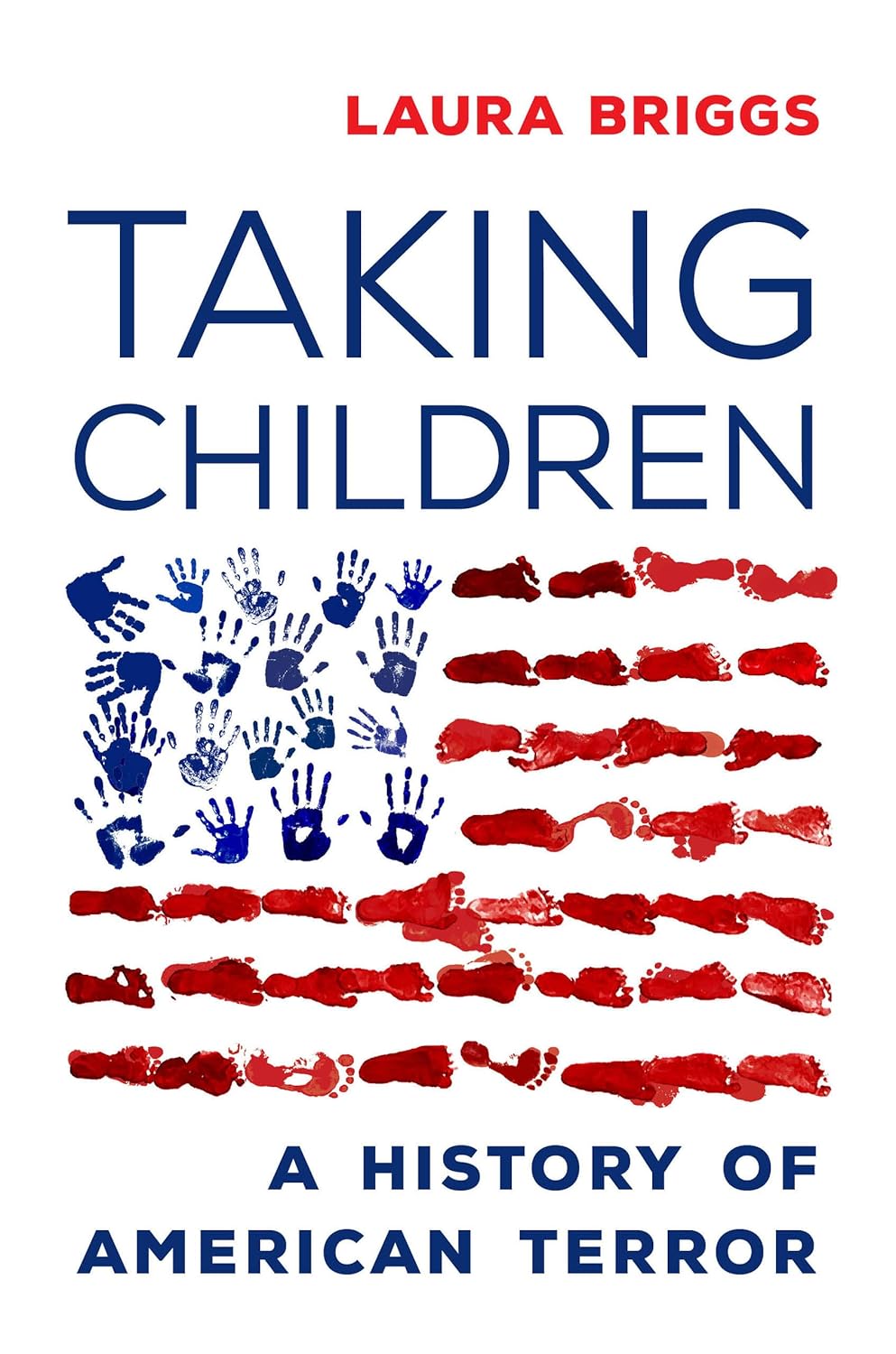
Pressley gave as succinct as possible a summary, two years in advance, of the argument of Laura Briggs’s new book, Taking Children: A History of American Terror. To call the book “timely” is an understatement. Briggs traces the history of a very American practice of separating children from their parents—mostly poor and of color—against the parents’ will. Briggs adds US foreign policy, in the form of support for military regimes in Latin America that forcibly separated and “disappeared” children. But, otherwise, Pressley’s list hits the grim highlights.
Is “taking children” too broad a category for understanding such different phenomena as Native American children kidnapped and sent to boarding school and Black children separated from their enslaved parents? Briggs does risk flattening out her argument, by gathering many kinds of historical patterns under the category “child taking.” But the synthetic view has its merit. As critic Fintan O’Toole recently wrote in a different context: “To see history—at least the history of war—in terms of people is to see it not as a linear process but as a series of terrible repetitions: what happens to human flesh in episodes of organized violence is always and everywhere the same.” For “war,” swap in “racist violence,” or “genocide.” Once you are looking at the people, you see not just slaughter and rape, but the children taken, over and over, in a horrifying loop. As Briggs notes, since the 1948 Convention on the Prevention and Punishment of the Crime of Genocide, taking children has been recognized as a constitutive part of the crime. The best-known part of the 1948 definition of genocide is “killing members of the group.” But the last, lesser-known part of the five-point definition is “forcibly transferring children of the group to another group.”
Briggs describes the US, along with other democracies in Europe, as toggling between a racial nationalist set of politics and an uneasy liberalism. It is this back and forth, push and pull, that creates different varieties and patterns of child taking—some meant to be hidden, secret, others intended as a sickening, punitive, public spectacle. All child taking is not the same, but it is part of a recognizable historical pattern.