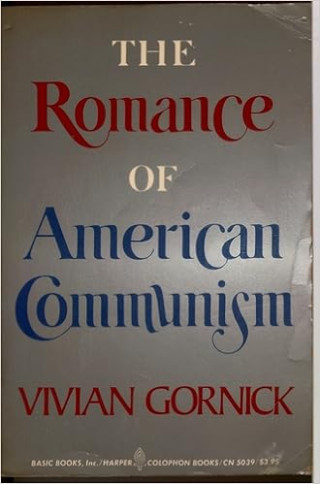
A few years ago, when I was spending most of my time organizing a graduate student union, people kept recommending a book: The Romance of American Communism. It was out of print, but I found a used, ex-library copy for a few dollars on Amazon, hardcover and silver with a giant portrait of the author, Vivian Gornick, on the back. When I finally got around to reading it, after our unionization efforts were quashed, the effect was like listening to a breakup song: this book got me, got what I’d been through, like nothing I’d ever read before. The Communists Gornick had interviewed for the book described feelings and experiences I recognized intimately but had never seen articulated. I put Post-it notes on nearly every page. I raved about it to friends the way friends had raved about it to me. Apparently, lots of other people did too; it became an underground sensation, so much so that the venerable left-wing press Verso Books has issued a reprint with a new introduction by Gornick—who is, by all accounts, confused and somewhat alarmed by the book’s revival.
When Romance was first published in 1977, there was no shortage of writing on the Communist Party USA—most of it memoirs by ex-Communists thoroughly disavowing their past lives, or denunciations of totalitarianism and the “captive mind” it produced. Romance was different. Gornick was a red-diaper baby; as she tells us in the book’s indelible first line, “Before I knew that I was Jewish or a girl I knew that I was a member of the working class.” She grew up in a household of “fellow travelers” in the Bronx, going to meetings of the Labor Youth League in a Prince Street loft decorated with posters of Lenin, Stalin, and Mao. Along with thousands of others, she abandoned Communism after the publication of Khrushchev’s “secret speech” in 1956, which detailed the mass repression, torture, and murder that had taken place under Stalin’s rule. But she didn’t recognize the world she knew in the subsequent literature decrying the Party. The Communists she had known weren’t depraved monsters or brainwashed automatons; instead “they were like everybody else, only more so.” The defining feature of belonging to the Communist Party (CP), the feature that Gornick set out to study, was an intensity of experience. You couldn’t really understand why someone would spend seventeen years trying to organize factory workers for the revolution by charting the pronouncements of the Comintern. Instead, for Gornick, the key to writing about American Communism was to relate what it felt like. From her interviews, she concluded that to be a Communist was to “experience a kind of inner radiance: some intensity of illumination that tore at the soul.” On every page you can find this sort of rapture. Who wouldn’t want to be a Communist?