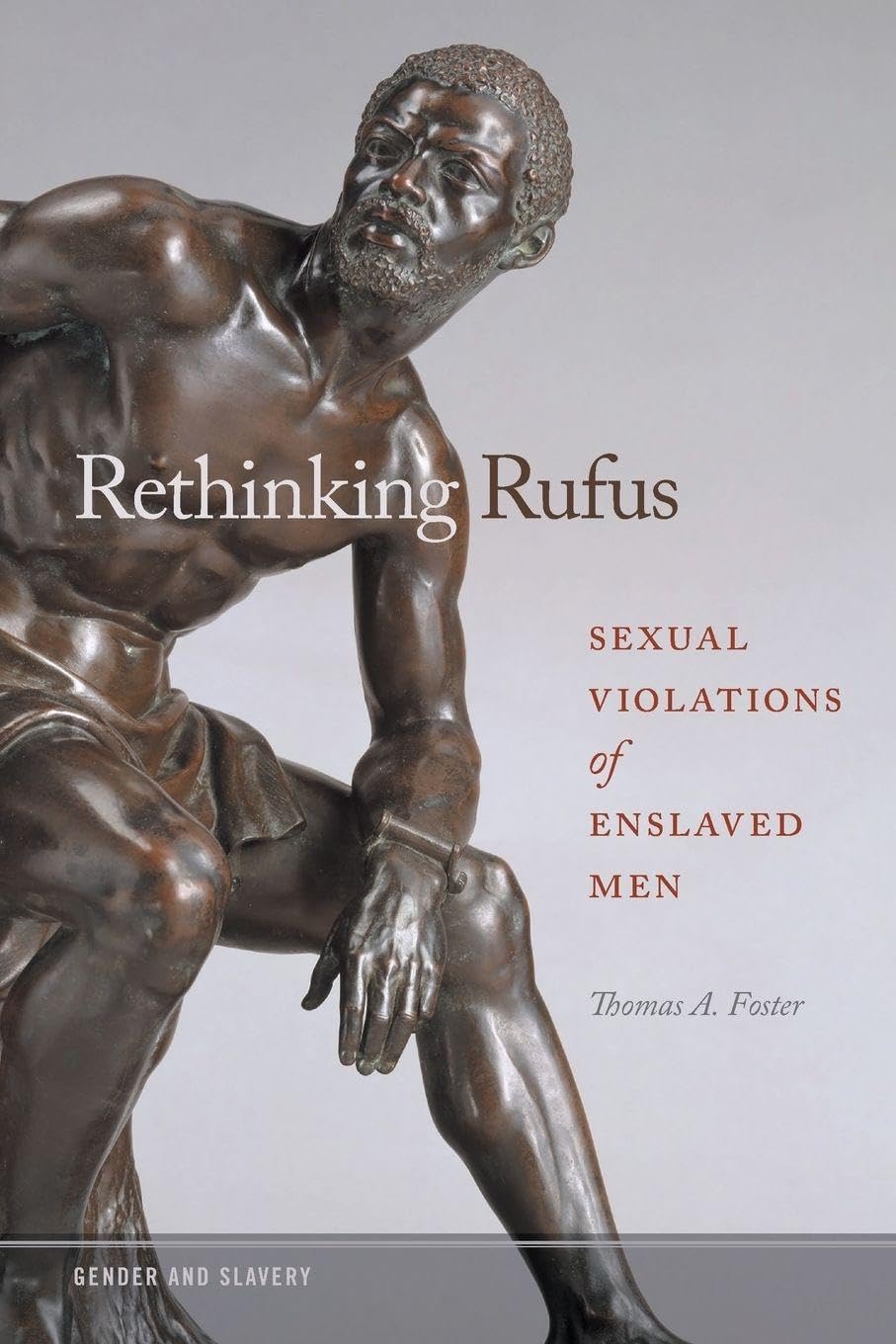
In your book, you cover the important historical work that shows just how brutal slavery was in terms of its economic and libidinal investment in the rape of Black enslaved women. From the example given by Douglass, and what happened to Rufus, however, both Black bodies were subjected to the “breeding” process, and hence both were victims. Elaborate on the process of forcing Black men to be “breeders.” Talk about how this is a manifestation of sexual assault.
Black men and women were expected to produce children because of the financial incentives created by a system that defined the children of enslaved Black women as born into lifelong bondage and as the legal property of the person who enslaved the woman.
Scholarly attention has rightly focused on the forced reproduction of enslaved Black women, but that focus need not come at the expense of understanding the position of enslaved Black men, who were also denied sexual autonomy, including the ability to choose with whom they would have children. When reproduction is compelled under threat of violence, sale, or punishment, it is a manifestation of sexual assault, even when it is not named as such in the sources.
To begin to take seriously the claim that enslaved Black men were sexually assaulted on plantations, one must confront white supremacist assumptions and myths regarding the so-called “hypersexual Black male.” In your book you write, “In the era of slavery, Anglo-American culture already embraced a message about Black men as particularly sexual, prone to sensual indulgence, and desiring white women.” How does one cut through these myths to even begin to accept the view that Black men can be victims of sexual assault — victims of white male patriarchal oppression?
One place to begin is by listening carefully to the voices of formerly enslaved Black men, as happens in Rethinking Rufus in a chapter that examines the importance of autonomy for enslaved and free Black men within family life and intimate relationships. The WPA Slave Narrative collection and other sources offer glimpses of how Black men resisted, adapted, and attempted to assert control over their intimate lives under extreme constraint.
Formerly enslaved Black women also sometimes wrote about violations they witnessed. As scholars have noted, Harriet Jacobs’s autobiography, Incidents in the Life of a Slave Girl, contains an account that strongly suggests the sexual violation of an enslaved Black man by a white man. Jacobs never names the assault explicitly, but her coded language — typical of 19th-century moral discourse — points clearly in that direction. She describes Luke as being chained to his enslaver’s bed and depicts the enslaver as sexually degenerate, engaging in “freaks of despotism” and “of a nature too filthy to be repeated.”