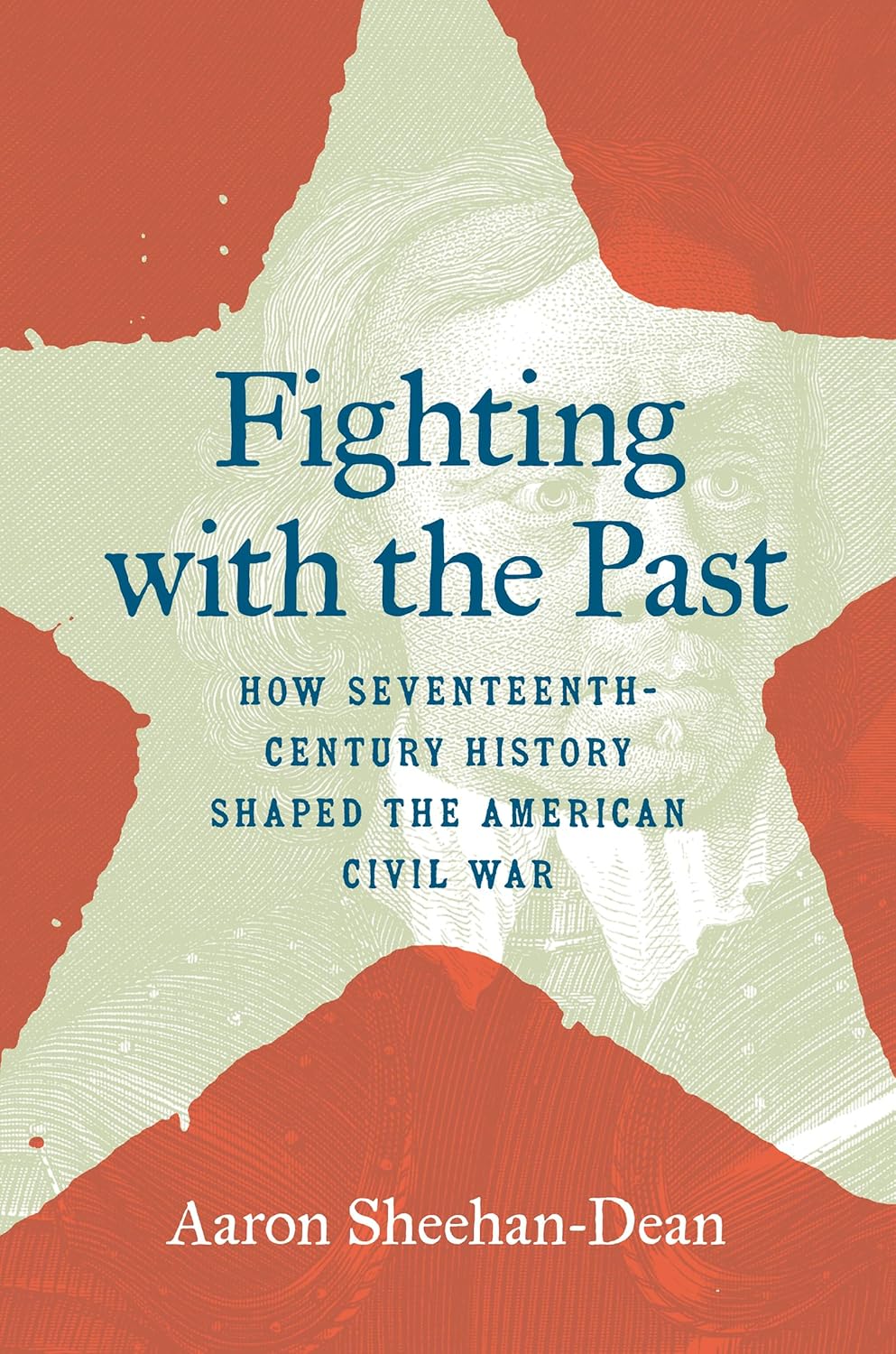
For the casual student (even learned scholars), what comes to mind with the American Civil War are its bloody battles, like Antietam and Gettysburg, its legendary military personalities, such as Robert E. Lee and Ulysses S. Grant, and its social consequences, like slavery’s abolition. Perhaps furthest from their mind is the war’s intellectual aspect. Not so with the latest work by Aaron Sheehan-Dean. In Fighting with the Past: How Seventeenth-Century History Shaped the American Civil War, Sheehan-Dean uses the “tools of intellectual history to consider Civil War Americans’ conceptions of the past.”[1] Participants “looked to the history of another civil conflict, the English Civil Wars of the seventeenth century, as they sought to navigate their crisis.”[2] Americans looked to the past for a blueprint for their present, or in the author’s words, “The lessons people drew from the seventeenth century shaped how they acted in the nineteenth century.”[3] An English struggle more than two centuries prior shaped their thinking, their rhetoric, and their understanding from the leadup to secession, throughout the bloody battles to subdue the Confederacy, and into the post-war attempt at Reconstruction.
Extrapolating meaning from the past for understanding the present is often fraught with contradictions. As Sheehan-Dean notes, these meanings were more emotional than intellectual, “reading histories selectively, creating a memory of the past that suited their present purposes.” These Americans were prone to interpret the past through subjectivity. Historical memories are often hazy and allow for very simplistic (euphemism for inaccurate) analogies. In an ironic twist, Confederates hoped for victory by identifying with the historical loser, while the Northerners, particularly the Radical Republicans, identified with Oliver Cromwell, whose idealism quickly degenerated into reestablishing authoritarianism. Rather than learn from the past and approach others with empathy and understanding, Civil War Americans “weaponized the past, using it to bolster preexisting arguments.” This drove Southerners to a “fatalistic millennialism.” They doubted man’s capacity for progress. Northern conservatives shared Southerner’ skepticism and cautioned about the excesses of revolutionary zeal. Republicans, both moderate and Radical, shared a belief in progress, but differed on patience . . . Radicals understood opportunity is fleeting, while moderates warned that change cannot come at the expense of constitutional norms and law and order.