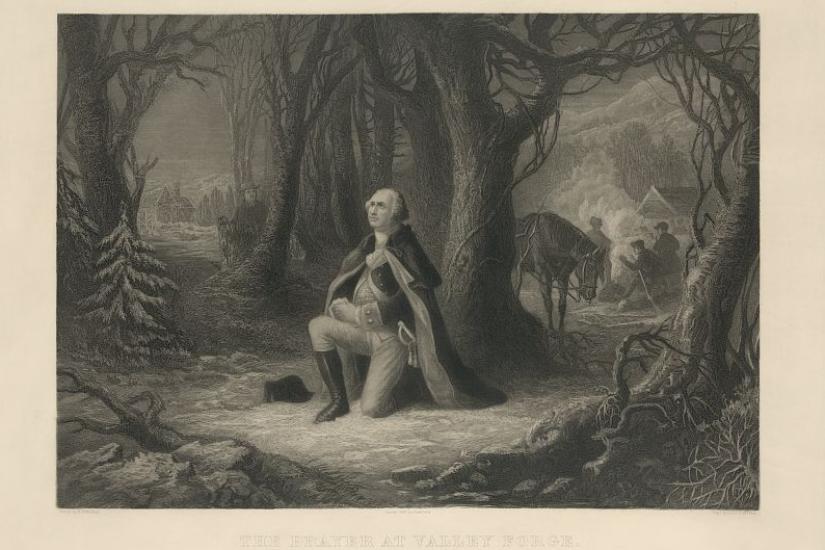
Did George Washington kneel in prayer at Valley Forge, as this image suggests? Before and after this 1866 engraving was printed in New York, some pious Americans offered an enthusiastic yes, proposing that it shows that America is a Christian nation entrusted with a divine mission. The scene, first recounted in an early nineteenth-century biography, has adorned everything from commemorative postage stamps to congressional prayer rooms, even though critics have called it a fabrication.
Unchurched separationists and liberal Christians have gleefully concurred. William E. Woodward, who coined the term “debunk,” penned a 1926 biography that accused the pious of “manufacturing” evidence to support their erroneous claims about Washington’s devotional life and the nation’s spiritual origins. Most Americans haven’t given the question a second thought, of course, and might shrug if pressed for an answer. However, the indifferent might want to find their way to an opinion since—you heard it here first—depictions of Washington kneeling in prayer will circulate widely in 2026, when the nation celebrates its 250th anniversary, just as they did when Calvin Coolidge’s administration put the image on a stamp celebrating Valley Forge’s 150th anniversary and Gerald Ford’s Bicentennial Commission featured it on a stamp commemorating the 200th anniversary.
It turns out, then, that there is a great deal at stake in the question, but how can well-meaning Americans arrive at an informed judgment about such historical debates when, as President Donald Trump observed in his 2025 inaugural address, there is a “crisis of trust”? The president’s critics agree about the crisis, but they blame it on him. Mistrust, social scientists say, has escalated in recent decades. Polls showed that Americans’ trust in religious and political institutions—and in institutions in general—was eroding by 1974, and many of us today don’t know who or what to trust. It helps only a little that scholars see causes for this mistrust: the fragmentation and consolidation of media, the disinformation campaigns for corporate profit or political gain, and the proliferation of local news deserts as small-town papers that fact-check officials continue to fold. While some defenders of democracy await the emergence of a coercion-free communications commons for the frank exchange of views, how can citizens find answers to historical questions that arise as the president is issuing executive orders aiming to “restore truth to American history” and historians are condemning the “federal censorship of American history”?