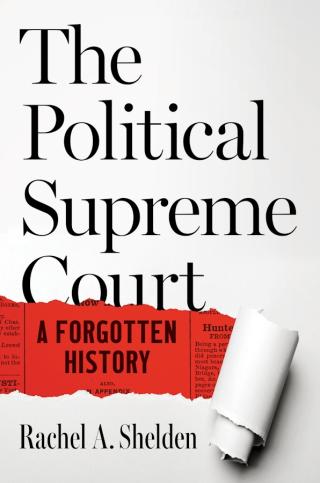
Today’s Supreme Court justices insist that they are not “politicians in robes” and merely act as umpires calling “balls and strikes.” But for the first 100 years of the nation, members of the Court were actively and openly involved in partisan politics. Justices penned newspaper articles and pamphlets, wrote or consulted on congressional legislation, campaigned for friends, and even ran for political office themselves while on the bench. Some were candidates for local or state office, but the presidency was often the most coveted prize; more than a third of sitting Supreme Court justices were presidential candidates in the nation’s first century.
This activity was not corruption or a violation of ethical standards. Justices engaged in politics because the Supreme Court was designed — and operated — as a political body, as I explain in my new book, The Political Supreme Court: A Forgotten History. Justices came to the bench from partisan political positions (rather than judicial ones) and were selected for their political experience. Once confirmed, they continued to participate in the world of partisan politics — and unlike our modern two-party system, that world featured multiple parties on the national, state, and local level that were constantly in flux. Through the federal court system designed by Congress, justices were also expected to represent individual regions of the country through the practice of “circuit riding.” In addition to his duties in the capital, each justice was required to sit as a circuit judge in his assigned region, presiding primarily over federal jury trials and interacting with the voters and partisan political leaders of their region.
Through their judicial opinions, in newspaper articles, in partisan campaign documents, and in speeches and addresses, members of the Court were also part of a broad political conversation about the shape and meaning of the U.S. Constitution. While today Americans generally accept judicial supremacy — the idea that the Supreme Court should serve as the final authority over the Constitution — 19th-century Americans did not subscribe to this view. Instead, the Constitution ultimately belonged to the people, who exercised their authority through their elected representatives and in popular protest.
The late 1850s, when justices were deeply enmeshed in the politics of slavery, is one of the historical moments that best captures the constitutional conversation and the broader political activity of the nineteenth-century Court. The adapted excerpt below recounts some of the ways that members of the Supreme Court mixed politics and constitutional conversation amid the infamous Supreme Court case of Dred Scott v. Sandford in 1857, as well as the popular political reaction to the decision.