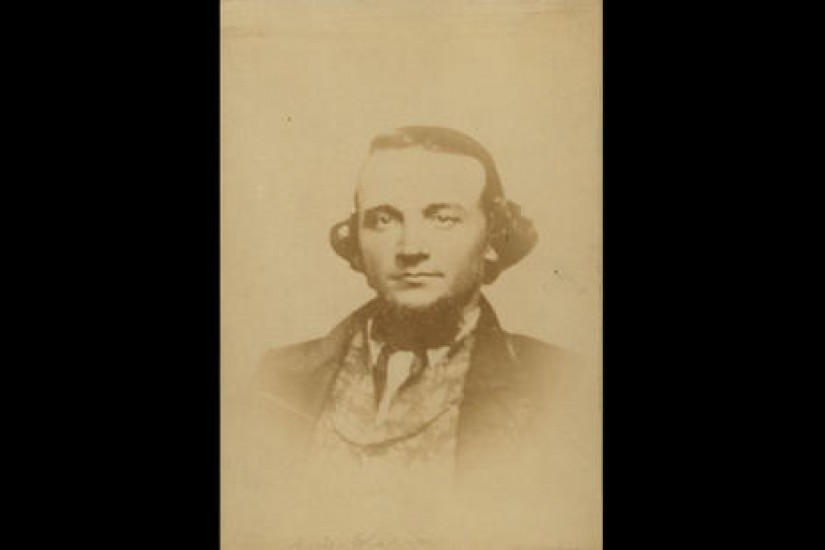
Waving a white flag of surrender after the failed raid on Harpers Ferry, Aaron Dwight Stevens was riddled with bullets to the face, neck and chest area. The handsome 28-year-old, who lost his baritone voice in the October 1859 crossfire, was hundreds of miles from home.
But he’d long deserted Norwich as a teenager, a rebel with a quick temper and yearning to fight slavery. In “Bleeding Kansas,” Stevens would join forces with famed abolitionist John Brown, of Torrington, training an army of 22 men to free the slaves — and first storm a federal armory in Virginia (now West Virginia).
Stevens, convicted of conspiring with slaves to revolt, was hanged on March 16, 1860. Nearly 160 years after his death, a group of Norwich-area officials and residents are requesting he be posthumously pardoned.
“Norwich has always been seen as the home of Benedict Arnold, but he was a traitor,” Tommy Coletti said of the Revolutionary War turncoat. “Here is a true American hero who is listed as a traitor also, but he wasn’t. He was doing work in the 1800s that you had continued in the 1900s with Martin Luther King.”
Coletti co-authored a biography about Stevens, “A Journey to the Gallows,” which gradually sparked the idea of asking the Commonwealth of Virginia to vindicate the New Englander.
The premise of the simple pardon is that the 13th, 14th and 15th Amendments — passed after the Civil War — nullify Stevens’ slavery related crimes.
“It is ironic that Stevens was actually convicted of the capital crime of inciting slaves to rebellion, which of course is no longer a capital crime. Slavery ended,” said Dale Plummer, the Norwich city historian. “I think this is a very timely move to request a pardon for this man — it might actually happen.”
Plummer said with the controversial removal of Confederate memorials throughout the South, it’s important to honor people who gave their lives to the anti-slavery movement.
In 2016, Route 138 in Lisbon was designated the Aaron Dwight Stevens Memorial Highway. And in Norwich, Plummer would like to see a bronze statue of Stevens erected on the city green — if the pardon is successful.
It may take more than a year to learn the outcome. The Secretary of the Commonwealth of Virginia has received the application and will review it before Gov. Ralph Northam makes a decision, a representative from the press office confirmed.
In the package of paperwork mailed last month, Vic Butsch attached photocopies of Stevens’ army enlistments, indictment and proof of death one day after his 29th birthday.
Butsch, the co-author of “A Journey to the Gallows” and lead researcher on Stevens, traversed the country for over a decade to review original documents. He first learned about the “Indiana Jones” figure through a continuing education class taught by Plummer.