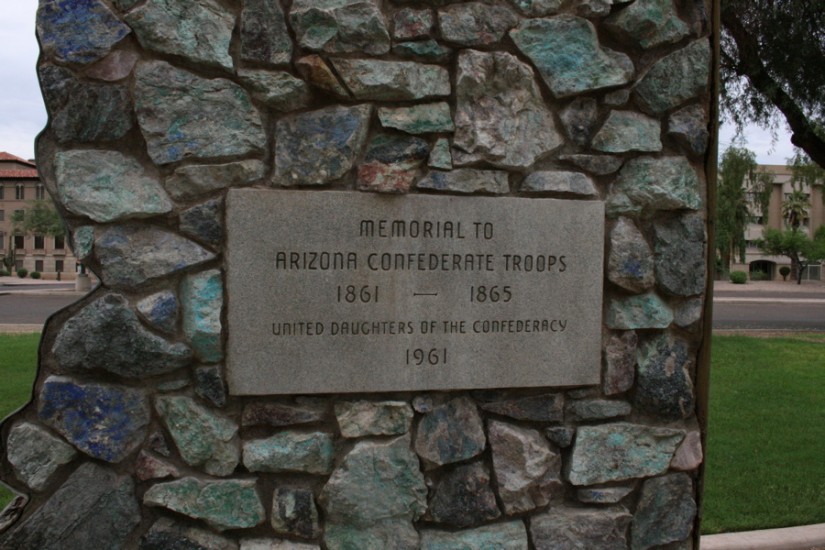
The news that black community leaders are calling on Governor Doug Ducey to take down six Confederate memorials spread around the internet on Monday night, prompting people around the country to ask, "Wait, Arizona was part of the Confederacy?"
The answer is yes, kind of: Southerners who settled here briefly claimed the lower half of the state (which back then was only a territory) for the Confederate States during the Civil War. During that time, the federal government never recognized the fact that a portion of the Arizona Territory had abandoned the Union.
But Arizona's Confederate memorials don't date back to that era.
They tell another, even less well-known story: one of white Southerners who moved to Arizona in the post-World War II era and brought their fondness for intimidating black citizens with them. The state's oldest Confederate memorial was dedicated nearly 80 years after the Civil War ended, in 1943. The newest, shockingly, went up in 2010.
For decades after the end of the Civil War, there was little effort made to commemorate the fact that Arizona had been on the wrong side of history. As historian William Stoutamire details in the Journal of Arizona History, most supporters of the Confederacy either left Arizona or were arrested for treason after Union troops from California showed up in Tucson.
When the Civil War came to an end, people who had sided with the Union returned to southern Arizona, vastly outnumbering the remaining Confederate sympathizers. The Arizona chapter of the United Daughters of the Confederacy didn't get started until 1919 — some 30 years after similar groups honoring Union veterans had been established here.
And so-called heritage groups intended to honor the Confederacy weren’t exactly welcomed with open arms. In 1928, when the Arizona Pioneers’ Historical Society and the Southern Pacific Railroad dedicated a monument to the three Union soldiers who had died at Picacho Pass, they deliberately declined to invite the United Daughters of the Confederacy to the ceremony.
It wasn’t until the mid-1950s that Confederate heritage groups became a significant presence in Arizona, which Stoutamire attributes to the state’s population boom during that era.
“As thousands of Southerners moved to a drier climate, they brought with them an identity grounded in the constant presence of Confederate symbols,” he writes. “Confronted with Arizona’s secessionist history, they felt the need to memorialize and commemorate the Confederacy’s attempted extension into the Southwest.”
By then, the civil rights movement was ramping up across the country. Not coincidentally, honoring the Confederacy suddenly became a popular pastime for white people with a tenuous connection to the Old South.