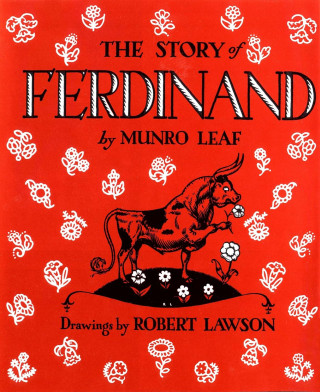
Just as he had made an accidental debut in the bullring, Ferdinand was soon thrust onto the international stage. Rightly or wrongly, readers understood the book against the backdrop of the conflict raging in Spain and the tensions that would shortly erupt into World War II; they responded to its peaceable hero according to their political priors. Some attacked the friendly bull for his pacifism, prompting a defense from The New York Times: “There are those who love Ferdinand for his own sake, and don’t care whether he is a Nazi or a Communist, so long as he is true to himself.” The kerfuffle became the subject of a January 1938 “Talk of the Town” piece in The New Yorker. “Ferdinand has provoked all sorts of after-dinner conversations,” it remarked. “Some say he’s a rugged individualist, some say he’s a ruthless Fascist who wanted his own way and got it, others say the tale is a satire on sit-down strikes—you see the idea.”
Leaf was mystified. In his speech at the book fair in 1937, he described how Viking had been bombarded with letters alleging “that here was something alarming, being spread under the cloak of juvenile literature.” Was Ferdinand “Red propaganda” or “Fascist propaganda” or an artifact of “subversive pacifism”? Or, as at least one women’s club complained, “an unworthy satire of the peace movement”? Leaf rejected any such readings. The book, he later said, “was propaganda, all right. But propaganda for laughter only.”
All the controversy drove sales. By the end of its first year Ferdinand had sold 80,000 copies; by the following December it had outstripped Margaret Mitchell’s Gone with the Wind on the best-seller list. Life magazine called it “the greatest juvenile classic since Winnie the Pooh” and reported that adults were often buying the book “largely for their own pleasure and amusement.”
Urbane readers in New York weren’t the only ones who perceived Ferdinand as a parable. In Spain, the book was banned until Franco’s death in 1975. In Germany, the Nazis had it burned as “degenerate democratic propaganda.” (After the war the Jewish journalist Jella Lepman, founder of the International Youth Library, worked with the US Army to distribute 30,000 copies to German children.) For Gandhi, the book encapsulated the philosophy of ahimsa—nonviolence. Eleanor Roosevelt also professed herself an admirer; as The Washington Post recalled on Ferdinand’s fiftieth anniversary, in her keynote speech at the 1937 Newbery Medal award dinner, the first lady apologized for not having read that year’s winner (Ruth Sawyer’s Roller Skates) since the story of the bull was “the only children’s book she had read recently.” Her husband had asked that a copy be sent to the White House. In the decades to come, as the Post reported, there were periodic calls “for Munro Leaf and Robert Lawson to receive the Nobel Peace Prize.”