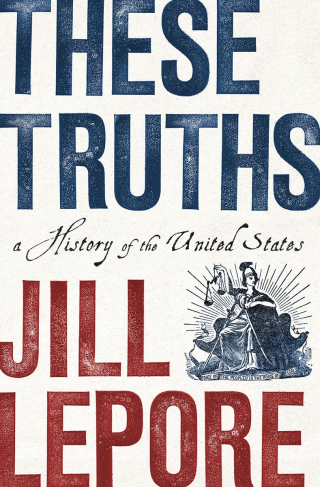
Americans, of course, have never exactly agreed on why this country was founded or what it stands for. Fierce arguments over those questions have long divided families and roiled politics, and even once produced a bloody civil war. But throughout the 19th century and well into the 20th, a simplistic patriotic narrative prevailed. “Providence designed that on this continent should be seen an example of democratic government,” a textbook explained to young students in 1872, “which means government ‘of the people, for the people, by the people.’ ”
Americans defined their nation in this way, by their commitment to a common creed—of equality, rights, and opportunity—and to a corresponding set of democratic ideals that they were modeling for the world. In practice, they generally fell short of those principles, sometimes seeming to pursue their abnegation more than their fulfillment. But the white men who built their fledgling republic around an idea, instead of around a common ancestry, opened the possibility that any who subscribed to its creed could become a citizen. Over time, other Americans demanded that the nation live up to its ideals and recognize their equality. For more than two centuries, our creedal nationalism has been a source of strength, binding together Americans of diverse faiths and backgrounds.
But lately, we have discovered that it is also a vulnerability. A nation defined by blood and soil—built around a shared religion or ethnicity—can survive divergent narratives. To a country built on an idea, though, and bound together by a shared understanding of our history, the inability to tell a common story might well prove fatal.
In recent decades, the traditional American story has come under sustained attack from both flanks. On the left, scholars and activists suspicious of nationalism have pushed to redefine the United States as a country exceptional mostly for its flaws and crimes. On the right, politicians and commentators hostile to diversity have sought to gloss over those sins and, more recently, lay claim to the nation on behalf of “heritage Americans.” Unable to agree on how to tell our story, we have swiftly abandoned efforts to tell it at all. The hours devoted to social studies in schools are shrinking, and survey courses in American history are vanishing from college campuses. The signature event of the nation’s 250th birthday might prove to be not a keynote speech or a patriotic pageant, but a no-holds-barred UFC fight on the South Lawn of the White House.
Most Americans are still proud of their country—although the percentage has been declining with each successive generation, and the decline is particularly steep among young progressives. If patriotism is going to be a word that can be used in polite company, then we will need to figure out how to tell the story of ourselves. Because without a coherent national story, we will fail to be a coherent nation.