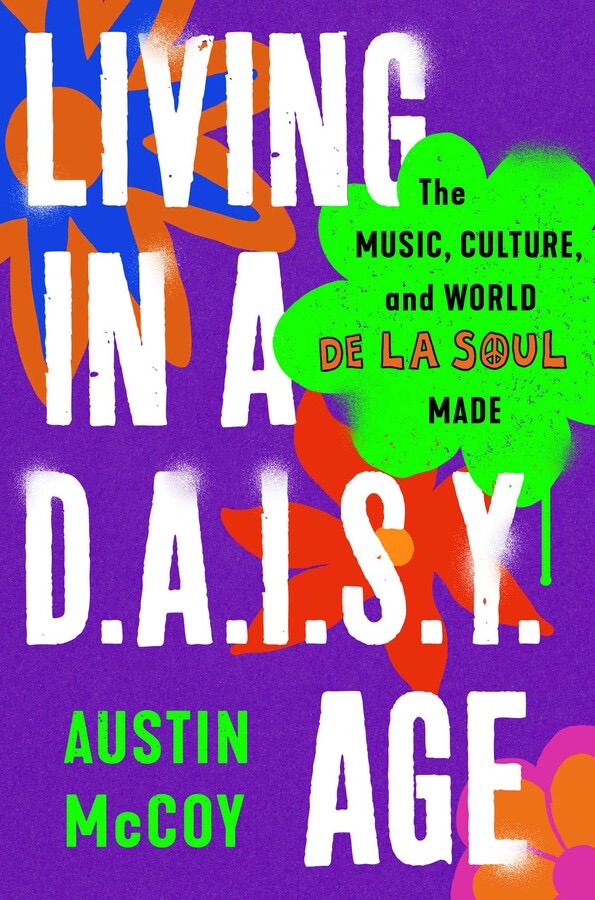
In Living in a D.A.I.S.Y. Age: The Music, Culture, and World De La Soul Made, Austin McCoy takes on the task of restoring one of hip-hop’s most innovative groups to their rightful place in the history of the genre. McCoy, a professor of History, not only provides a cultural reckoning but a personal history, a journey that begins in his youth and spans to the present day where he teaches a History of Hip-Hop in American Culture course, alongside his other areas of expertise, labor history and Civil Rights. McCoy’s meticulous discography threaded with a memoir of listening reminds us that our choices in music are not only cultural and political but also deeply personal.
McCoy begins in the classroom, where he is devastated (though not surprised) to learn that his students are mostly ignorant of De La Soul’s music because of the group’s longtime absence on streaming platforms, leaving gaps in their understanding of not only the group but its contributions to the genre of hip-hop. “De la Soul’s absence on the streaming platforms prevented younger listeners from seeing historical connections between their music and that of contemporaries, like Tyler, The Creator and Earl Sweatshirt,” writes McCoy, pointing out that, in this way, students and listeners are robbed of artistic lineage.
A self-described “80s baby,” McCoy owns physical copies of De La Soul’s albums (a topic that will become important by the end of the book), and he notes that the group—Posdnuous (Kelvin Mercer), Trugoy (David Jolicoeur), and Maseo (Vincent Mason), and their frequent producer, Prince Paul (Paul Edward Huston)—offered more than a new way to come at hip-hop. He argues that De La Soul infused hip-hop with a sense of imagination and creativity revolutionary to both Black art and Black life. Starting with the release of their first album, 3 Feet High and Rising, De La Soul showcased a complex-yet-integrated methodology that elevated the rap album to high concept art. The group’s approach to sampling, dense and layered, created a finely textured sonic tapestry that made rap more melodic, an almost handcrafted sound, which McCoy aptly describes as “stitched.” This artistic style supported the futurism De La Soul embodied, encapsulated by the “D.A.I.S.Y. Age” aesthetic.
De La Soul not only expanded the sound of rap but its influence on its listeners, making a case for creative individualism. “They made it okay for young Black men, and young men of color to be weird, quirky, and vulnerable,” McCoy writes. He points out that De La Soul enacts what scholar Robin D.G. Kelly calls “Black freedom dreaming” (or in De La Soul terms, “utopia set to music.”) “D.A.I.S.Y.,” a philosophy that underpins De La Soul’s first album, stands for “Da Inner Sound Y’all,” and it sets forth an ethos based on creativity, intelligence, wit, and delight. Drawing on a range of samples, from funk to Schoolhouse Rock jingles, De La Soul expanded what could be considered fodder for hip-hop music. Ironically, this wide-ranging sampling would soon create the quagmire that kept De La Soul’s albums off the streaming services, depriving future listeners of what McCoy describes as the group’s ability to tell many different types of stories using rap.