In the nineteenth century, empires fought over science and resources and land. But they also fought over poetry. “The Americans,” John Quincy Adams wrote to his father, “have in Europe a sad reputation on the article of literature.” The young diplomat hoped to change this: “I shall purpose to render a service to my country by devoting to [poetry] the remainder of my life.”
Adams would serve in other ways, but he was right to worry. During this period, a nation’s literary achievements could provide patriotic pride and a measure of national success—or national failure. “In the four quarters of the globe,” sneered one British critic, “who reads an American book?”
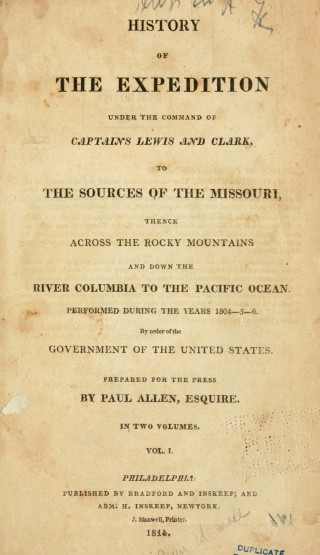
Meriwether Lewis and William Clark also hoped to change this. Thomas Jefferson had many goals for their expedition, and one of them was literary. When the captains returned in 1806, they did so as international celebrities. Lewis quickly announced that he was writing a book in three volumes—the first a narrative of their epic journey, the second a survey of the Native nations they’d met, the third a volume of science, all of it accompanied by a massive map from Clark that would finally fill in the North American interior.
Given Lewis’s literary talent, and given the expedition’s global fame, this book seemed destined to be the third great work of American nonfiction, joining Jefferson’s Notes on the State of Virginia and Benjamin Franklin’s Autobiography. But Lewis never submitted a word. “Everybody is impatient,” Jefferson wrote to him in 1809. It was the last letter he ever sent his friend.
That same year, in the fall, Lewis killed himself. The reasons for this were as complicated as the expedition itself, and those complications bled into one another. One of the documents I uncovered while writing my new book on Lewis and Clark was a letter from Adams, who shared a dinner with Lewis a few days after his return. The great explorer, John Quincy wrote, was “more altered in manners and appearance…than I ever beheld any man.” Adams could not believe how much the expedition had worn Lewis down. “I did not know him again, though I expected to meet him,” Adams wrote. “He looks fifteen years older.”
With Lewis gone, the book fell to a grieving Clark. He ended up working with Nicholas Biddle (the same Biddle who would later battle Andrew Jackson in the Bank War). Biddle studied the journals from the captains and their men, which ran to more than a million words. He asked Clark follow ups, and Clark asked his men, including Toussaint Charbonneau. This meant Sacajawea also contributed her insights, indirectly or not.