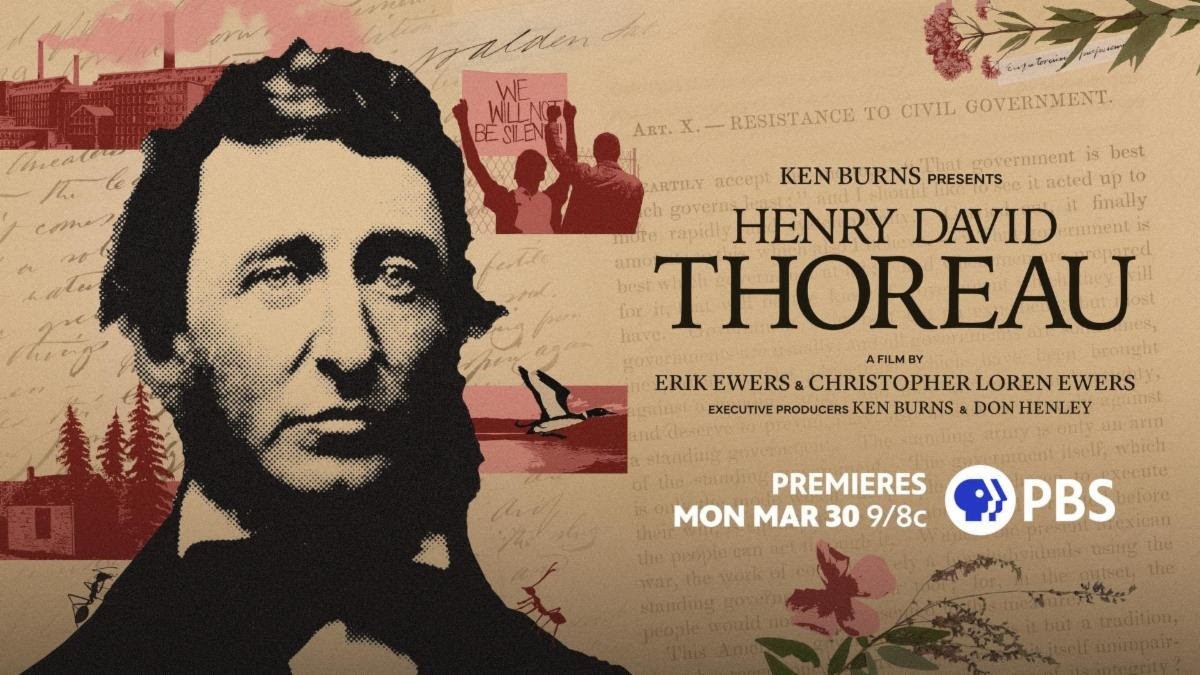
Ed Rampell:
Ken Burns executive produced Henry David Thoreau. His last documentary was The American Revolution. Is Thoreau in a continuum of thought from the Revolution to his own time?
Erik Ewers:
Absolutely. When he was born in 1817, the country was thirty-seven years old. Already it was struggling to live up to its own ideals. There was already corruption and divisiveness in the government, which was reflected in communities across the country. There were so many parallels that were coming to light in his time that are evident in ours. Democracy is an experiment. It was still trying to figure out what it was going to be. Maybe that’s the point of democracy — it’s always an experiment and always trying to figure out who and what it is supposed to be.
In light of all that, Thoreau was growing up in a world he was increasingly disappointed with. By the time he graduated from Harvard, he really questioned his own identity and how he wanted to operate within this society that was so filled with obligation and what he called “the mass of men [that] lead lives of quiet desperation.” Like any democracy, he recognized that either you can sit and do nothing, or you can start reacting to it. And his first step was writing about it.
He befriended Ralph Waldo Emerson, who became his mentor. Thoreau is Emerson’s protégé, and he chooses to start writing about the times that he’s living in. The first lecture that he did was an essay called “Society and Solitude”; he spelled out all the things he found troublesome. As you go through Henry’s life you see both him and the country struggling to understand everything: What does freedom mean? What is our role in connecting with nature and the way we use it as a commodity for consumerism? It was just an ongoing thing.
It’s no accident that he was the guy who finally penned “Resistance to Civil Government,” later called “Civil Disobedience,” because he realized the only way an individual could change, is to not just read but act. To step up to the plate. He willingly went to jail because he was not going to pay a tax that would support a state and federal government that still allowed slavery. And also the Mexican-American War, which was a land grab by the United States. He put his foot down, it was his little statement; a lot of people ridiculed him for it in town. Even people who had done something like that before him didn’t step up and support him. It just started him off on a path of individualism that he never left.