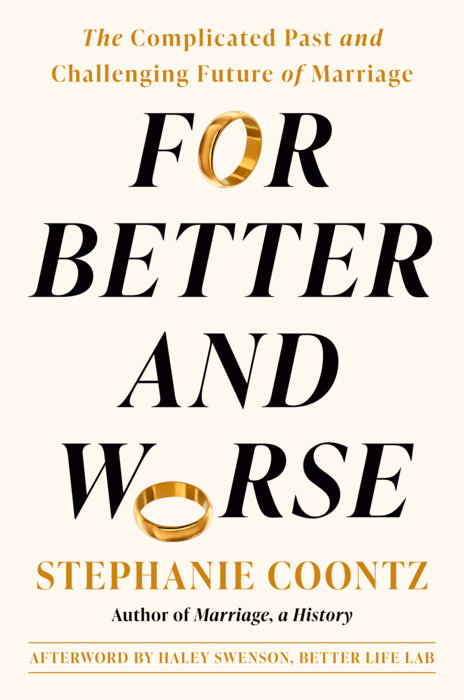
For Better and Worse arrives at a moment when the sexes are more polarized—at least politically—than ever. Coontz is trying to address two extremes: those who reject egalitarianism in favor of a romanticized past, and those who reject heterosexual marriage as inherently exploitative. She avoids culture-war zeal, aiming to approach everyone with sympathy. In her earlier work, she went after “unhealthy nostalgia.” Here she acknowledges having been “too dismissive” of how fears of losing money and status can encourage fantasies of an idealized past. Psyches are a “jumble of internalized messages and habits” that defy reason. Talk to any couple made up of two good people. Even those who want to change often struggle to do it.
Coontz, incidentally, is married, though she doesn’t talk much about it in her books. Early in her career, she got engaged, but “the wedding fell through,” she once told The New York Times. It then turned out she was pregnant. She was a single parent for a dozen years until she reconnected with, and married, the man who’d been her college sweetheart. The writing of For Better and Worse was delayed by the birth of her first grandchild. The book is dedicated to him.
For Better and Worse struck me as particularly generous toward young men. When Coontz started studying the history of the family, she was focused on “what women lost when they were denied access to the expanding economic and political rights that White men gained in the late eighteenth and early nineteenth centuries.” Now she is “more aware of what men lost” when work pulled them away from the intimacies of family and community life.
In the Victorian era, men wrote love letters expressing their longing and devotion: “I cannot have a separate existence from you, I breathe by you; I live by you.” Before his wedding to Alice Lee in 1880, the 21-year-old future Rough Rider and then-virgin Teddy Roosevelt boasted in his diary: “Thank heaven I am absolutely pure. I can tell Alice everything I have ever done.” But this more sensitive masculinity didn’t much help men in a commercial world that rewarded strength and assertiveness, even ruthlessness. Women who depended on men for their livelihood began to prize those traits as well. The idea of the attraction of opposites took hold, and Coontz quotes women worrying in their diaries and letters that potential suitors were “too soulful”—not “masterful” enough. For many, Coontz writes, the ideal man was “powerful, stoical, and forceful.”