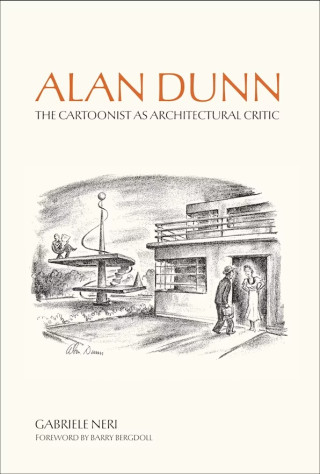
In 1936, Alan Dunn was paid $25 for his first cartoon in Architectural Record. The drawing shows a scene from American suburbia, with two single-family houses side by side. On the right, we see a modern, geometrically abstract abode with large windows set into very slim walls, a flat roof, bright metal parapets, and no traces of decoration. In short, a work of architecture aligned with the new avant-garde style spreading across the country.
But to the left, another house appears — one with much bolder features. It is composed of a post set into the ground on which two bare slabs are wedged, which constitute the entire living space on their own. The elevated living space is reached via steps with a curved handrail that rises from the ground to the top. There are no other pillars, not even walls, a roof, or windows. The house, in its sculptural incompleteness, is an exercise in absolute radicalism. Looking perfectly at ease, its inhabitant reads the paper, lounging on a futuristic chair, seemingly unperturbed by issues of privacy or climate control. This display gets on the nerves of his modernist neighbors, irritated by such extreme modernity.
“Well, we’re dated!” the wife complains to her husband. “That abstractionist next door built his house in space-time.”
It is a typical setup by Dunn, then a mainstay of The New Yorker’s graphic humor, notorious for satirizing the transformations of 20th-century American architecture. Trained at the National Academy of Design and the American Academy in Rome, Dunn was a shrewd visual critic who brilliantly juxtaposed everyday aesthetic banality with surreal disruption. He showed that, rather than a matter of substance, the modernity seeping into Americans’ lives was, above all, a phenomenon of form — a passing fashion soon to be supplanted by new trends and convictions.
This was a theme Dunn played on throughout his career.
Take one of his earlier drawings in the pages of The New Yorker: In the midst of a forest stands the typical silhouette of a rationalist house made of reinforced concrete, with squared shapes, ribbon windows, and cut-out corners, in the style of architects Walter Gropius, Le Corbusier, and their colleagues. But here, the maximum geometric “modernity” clashes with an antithetical and unsettling situation: The house is shown in a state of total ruin and abandonment, with dangling window frames and a “for sale” sign. We see that modern architecture, despite the proclamations, already belongs to the past.