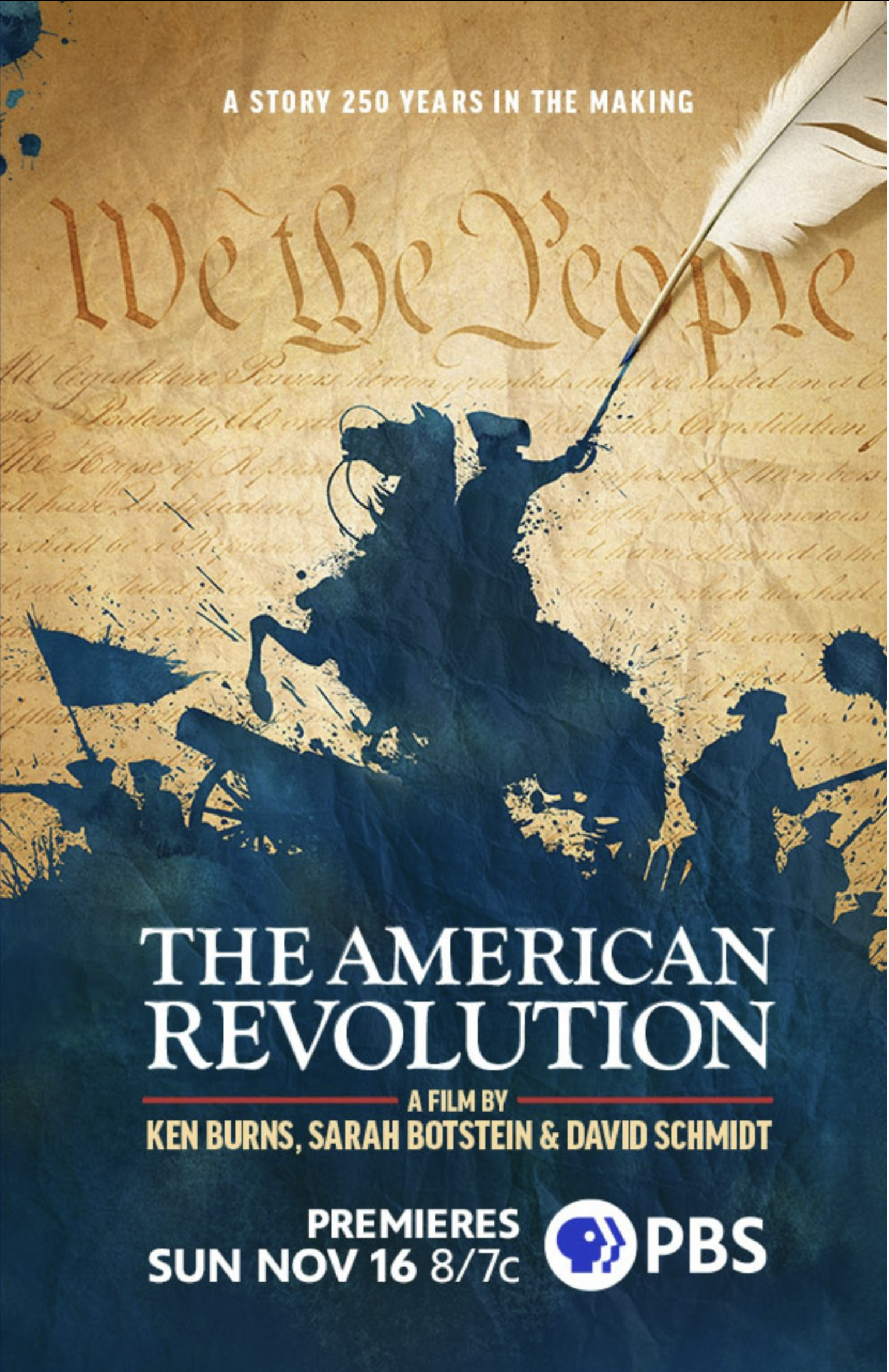
Ed Rampell Your narrator calls the American Revolution “the most consequential revolution in history.” As you know, the revolution has largely fallen out of favor with most of the Left, which often belittles it as being led by slaveowners and merchants, as your own film demonstrates.
Ken Burns I’m not sure I’d agree that it has fallen out of favor. But that said, I’m not particularly interested in historiographic fads. I’m interested in experiences and stories, in all of their diversity. I think you can tell a full story — and often a hard, contradictory story — and still highlight what speaks to us in a singular voice across time. I’ve said, and continue to believe, that the American Revolution was the most important event in history since the birth of Christ. It changed how we think about government and rights and had a tremendous impact on the world.
Ed Rampell Your new film covers the role of the indigenous and black people in the thirteen colonies during the War for Independence. Let’s start with the native nations. Your film notes the British-decreed “Proclamation Line of 1763,” which prohibited Anglo colonizers from moving West of the Appalachian Mountains. But speculators secured land there for Washington and other founders. How much was the desire for what became known as “Manifest Destiny” a driving force for the war against the British?
Ken Burns We say in the opening lines of the film that “the American Revolution was not just a clash between Englishmen over Indian land, taxes, and representation but a bloody struggle that would engage more than two dozen nations, European as well as Native American, that also somehow came to be about the noblest aspirations of humankind.” So yes, the war was very much fought over westward expansion. But I think you can explain that and still acknowledge the meaning of liberty, again with all of the contradictions involved.
Ed Rampell Many founders, including [George] Washington and [Thomas] Jefferson, owned enslaved people. On the one hand, according to your film, free blacks were welcomed into the Continental Army, which was more integrated than any US military force until [Harry S.] Truman desegregated the armed forces after World War II. On the other hand, years before [Abraham] Lincoln’s Emancipation Declaration, Lord Dunmore’s Proclamation of 1775 granted freedom to black Americans willing to fight for the British.
Ken Burns The Dunmore Proclamation sought, as you know, to exploit slavery to the advantage of the British, even when many of the British officers involved, including Lord Dunmore, were slaveowners themselves. What’s of interest here, all the more given the complexity of this war and the ideas around it, was how people on all sides were expressing their agency and looking to navigate the conflict in ways that were hopefully most beneficial to them.