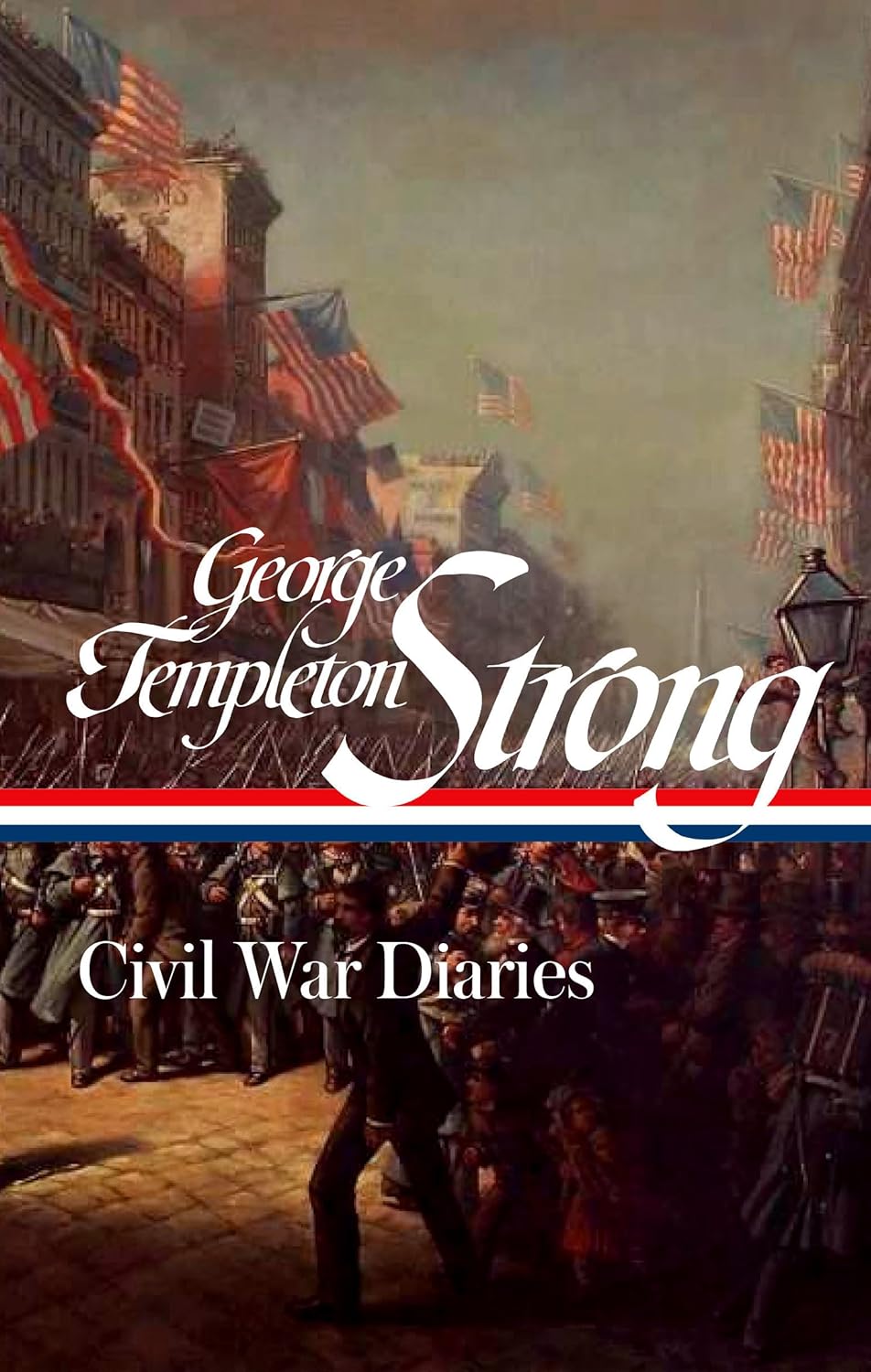
I must have heard of Strong while watching the initial 1990 broadcast of Ken Burns’s The Civil War, in which some passages from his diary were read in suitably patrician tones by George Plimpton. But it didn’t stick, it was just one of many names I hadn’t known before, and it registered only when I read the Library of America’s The Civil War: The First Year Told by Those Who Lived It (2011). Three pieces from his diary were reprinted there, with more in the later installments of that four-volume series, and though he was far from the battlefield what immediately struck me was the quick vivacity of his prose. The second of those excerpts concerned the beginning of the war, with the Confederacy’s attack on Fort Sumter in Charleston’s harbor—not the cannon fire but rather the atmosphere of rumor, confusion, alarm, and at times exhilaration in which Strong’s New York tried to follow the news. Here he is, in Wisner’s edition, on April 12, 1861, a Friday:
War has begun—unless my Extra Herald lies—
….Walked up town with Gouv: Ogden & that wooden headed Dunscomb. The streets were vocal with newsboys—“Extry-a-Herald! Got the Bombardment of Fort Sumter!!”
We concluded it was probably a sell and that we would not be sold, & declined all invitations to purchase for about four blocks. But we could not stand it longer—I sacrificed sixpence & read the news to Ogden—& that galvanized pumpkin Mr D. by the light of a corner gas lamp.
Poor Dunscomb is identified as one William E. in the index; he apparently served with Strong at Trinity Church, and a later entry describes him as “prosing [on] at the zero point of absolute stolidity.” The guns had opened at 4:30 that morning, and the word had reached New York by telegram; bulletins from the eastern battlefields arrived quickly throughout the war, sometimes so quickly that the first reports had to be corrected by later blasts of Morse code. With Sumter the news was accurate enough, though Strong also wrote that he could “hardly hope that the Rebels have been so foolish & thoughtless as to take the initiative in Civil War & bring matters to a Crisis.”
Two days later came definitive news of the fort’s surrender, and Strong told himself that now the North’s backbone and resolve had been strengthened, that it was finally time to call the bluff of a region given to “brag & lying.” Surely the South couldn’t really want a war? He thought Lincoln’s call for troops must inevitably make the whole idea of the Confederacy crumble, and he believed that in any case Virginia would stay with the Union. It didn’t, and on May 4 he already had to write differently: the new “levies are very raw—the rebel commanders have the energy & freshness that belongs to revolutionary leaders. I have a foreboding that the campaign will begin with defeat and disaster.”
