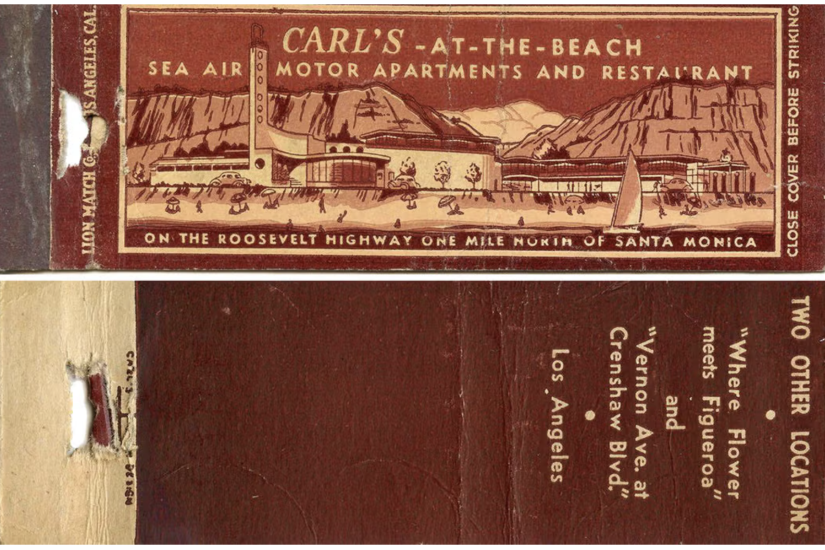
In film noir, a matchbook is never just a matchbook. Found in a victim’s apartment or a suspect’s lair, it leads to a last known location or crime scene; opened up, it reveals scribbled notes or hidden messages. The peculiar centrality of these pocket-sized throwaways in a genre perfected in the mid-twentieth century speaks to both their ever presence in everyday life during this period, and to the curious way that meaning adheres to disposable things.
It’s fitting, then, that a collection of matchbooks should hail from the region that produced film noir, and whose contradictions—between sunshine and darkness, promise and ruin, dreams and destruction—often served as its setting. The Eric Wienberg Collection of Malibu Matchbooks from Pepperdine University, which contains matchbooks and other local ephemera from the late nineteenth century through the 1980s, serves—like any good noir clue—as evidence of something bigger: a vanished mid-century Southern California commercial corridor, long displaced by fire and time.
The history of the familiar, ad-emblazoned matchbook mirrors that of California itself, both temporally and thematically. Indeed, like the journey of a covered wagon headed west, the quest for an on-demand flame was long, quixotic, and perilous. Though it began with the discovery of phosphorus and its incendiary properties in the seventeenth century, the introduction of the friction match in 1827 marked the arrival of the strikable, stick-based form we know today. These so-called “Lucifer” matches had serious downsides, however: their tendency to spontaneously ignite led railroads to refuse to carry them, while the white phosphorus used in their production caused a horrific disfigurement known as “phossy jaw” among factory workers. The nonpoisonous safety match eliminated both toxicity and combustibility, arriving just in time to meet the unprecedented demand for matches sparked by the introduction of mass-produced cigarettes.
In 1894, the Diamond Match Company purchased the patent for the “Flexible Match,” consisting of a folded strip of thick paper containing cardboard matches. Direct sales to consumers flopped, but a new market was inadvertently invented in 1896 when the Mendelson Opera Company used the blank surfaces of matchbooks to advertise upcoming performances. The marriage of matches and marketing was more or less official by 1902, when Pabst Brewing Company ordered ten million matchbooks from Diamond Match, stamped them with its logo, and distributed them free—turning customers into advertisements every time they lit a smoke, and completing the matchbook’s transformation from consumer good to miniature billboard.