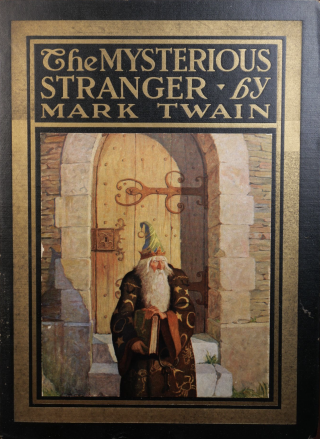
Throughout his career, religion was a favorite satirical target of Twain’s. As early as the late 1860s, as Twain’s popularity was rising, his dispatches from Europe and the Holy Land drew the ire of pious readers. The humorist’s irreverent jabs at the “imaginary holy places created by the monks” so offended one minister that he condemned Twain as “a son of the devil.”
After Twain’s death in 1910, The Mysterious Stranger: A Romance magnified this reputation. Published in 1916, the bleak narrative focuses on a satanic stranger who convinces the young narrator, Theodor, that God does not exist and that life is a grotesque dream. Scholars cite the text as evidence of the humorist’s late-life descent into pessimism and nihilism. It certainly seemed to reflect the mind of a man who had suffered bankruptcy and the deaths of his wife, Livy, and two of his daughters, Susy and Jean, during his final decade and a half.
As Twain’s last important work of fiction, The Mysterious Stranger came to be seen as the key to his last years, “a kind of Nunc Dimittis,” in the words of the scholar William Gibson. The critic Bernard DeVoto includes it among the “symbols of despair” he believes Twain had crafted near the end. Though it is inferior to Twain’s earlier works, DeVoto saw The Mysterious Stranger as having prevented the author from crossing “the indefinable line between sanity and madness.” Even so, he sees the story’s nihilistic ending as Twain’s literary detonation of the universe, by means of which he sought to absolve himself of guilt and responsibility.
Until the early 1960s, this dour view of Twain and The Mysterious Stranger was the scholarly consensus. Roger Salomon concluded in 1961 that, although in The Mysterious Stranger Twain had failed “to develop a coherent imaginative response” to life’s absurdity, at least he had succeeded “in making this absurdity vivid.” Writing a year later, the literary scholar Henry Nash Smith asserted that Twain had found a refuge from life’s futility only by identifying with Satan, a “supernatural spectator for whom mankind is but a race of vermin, hardly worth contempt. And this,” Smith concluded, “marks the end of his career as a writer, for there is nothing more to say.”
But the groundbreaking discovery in 1962 that The Mysterious Stranger was not the narrative Twain intended proved Smith’s report premature, if not greatly exaggerated. The literary detective work of John Tuckey found that the version published in 1916 was actually a patchwork of three different drafts Twain had worked on between 1897 and 1908, along with a bridgework paragraph he had not written. Tuckey also noted the alteration of characters’ names and the addition of an astrologer figure. Two of Twain’s drafts were unfinished: “Chronicle of Young Satan” (1897–1900) and “Schoolhouse Hill” (1898). The other, No. 44, The Mysterious Stranger, which Twain had worked from 1902 to 1908, was a longer work in multiple chapters and with a clearly marked conclusion.