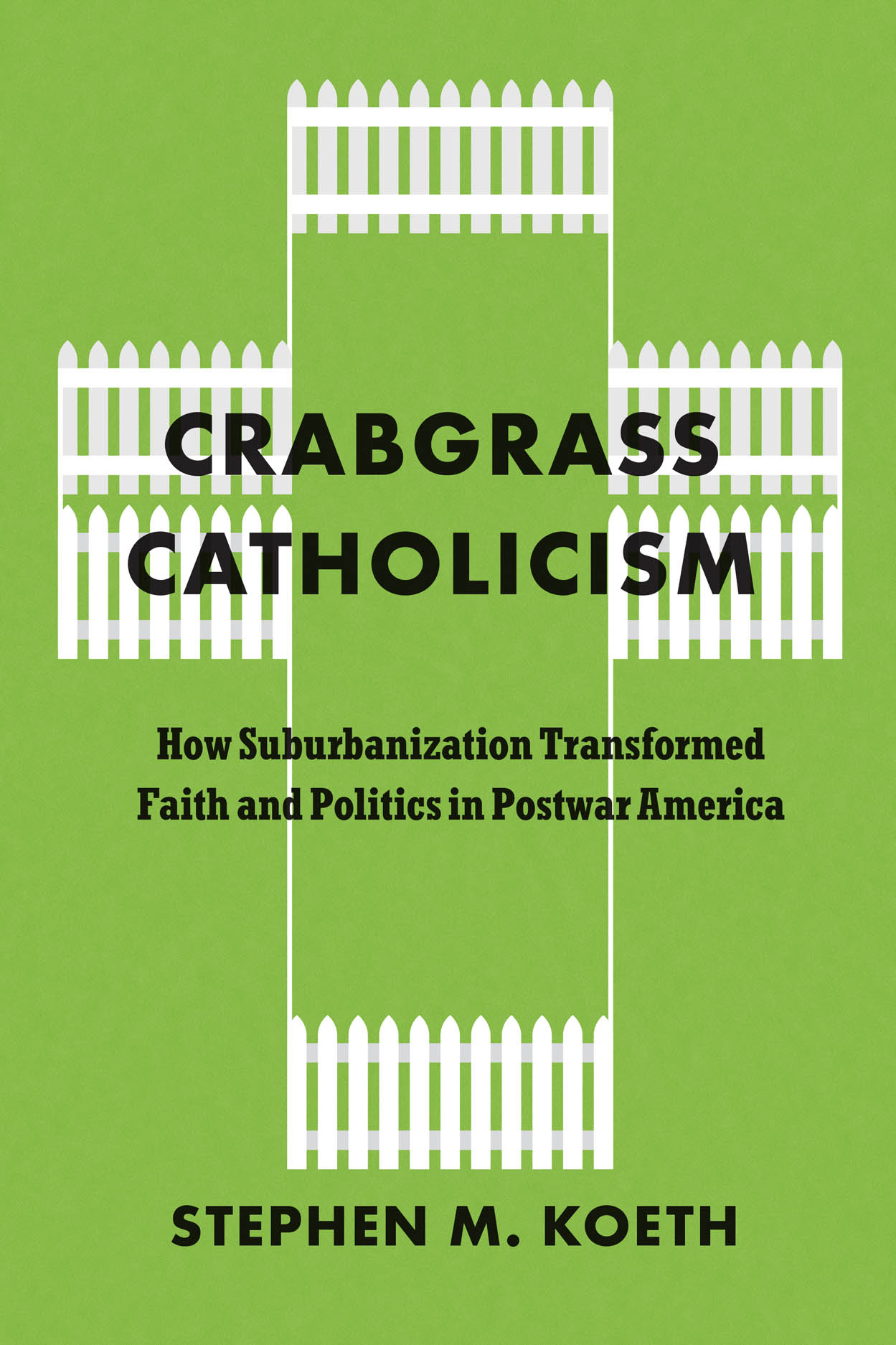
In most accounts of the Catholic Church’s twentieth-century transformation, the Second Vatican Council, with its sweeping changes to liturgy and the role of the laity, is presented as the watershed moment. But other forces were at play as well. One of the most important was the expansion of American suburban life—the steady exodus of people from the cities into what the historian Kenneth Jackson dubbed “the crabgrass frontier.” This demographic trend, beginning in the mid-nineteenth century and accelerating drastically in the early decades after World War II, had profound effects on the American Catholic way of life well before the Second Vatican Council concluded in 1965. That story is the subject of Stephen M. Koeth’s informative new book, Crabgrass Catholicism: How Suburbanization Transformed Faith and Politics in Postwar America.
Koeth’s canvas is a Long Island experiencing suburban hyper-growth on a scale unknown today. In the wake of World War II, GIs returned to marry their sweethearts but, amid a nationwide housing shortage, found few places to live. Due to a housing construction deficit during more than a decade of depression and war, many were forced to double up with family. The suburbs provided the cure: An end to wartime materials rationing and the invention of production-line-like techniques for building homes enabled the rapid proliferation of suburban housing developments such as Long Island’s famous Levittown. Despite their small size and limited amenities, homes in these new suburbs proved enormously popular.
Pent-up demand and rapidly emerging supply intersected to produce an explosion of suburban growth in the early postwar period. Many American suburbs grew so fast it was as if they sprung fully formed from the brow of Zeus. Nassau County, New York, grew by 93.3 percent between 1950 and 1960, gaining 627,406 people. Suffolk County, New York, grew by 141.5 percent during that same period, adding 390,655 people. This was followed by 69 percent growth the next decade, or 458,166 residents. Today’s biggest suburban growth stories are posting numbers well below these. Collin County, Texas, for example, in the booming North Dallas suburbs, has never added 300,000 people in any decade—this in a county comparable in size to Suffolk and much larger than Nassau. After their growth boom, both Long Island counties essentially flatlined. Nassau County has added fewer than 100,000 people since 1960. Suffolk County added more after 1970—up by 410,959—but this 37 percent growth was spread out over almost fifty-five years.