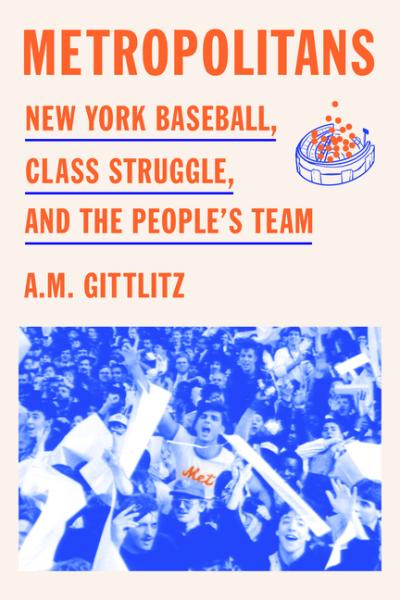
A.M. Gittlitz is only four years older than me, but he grew up with a different sense of the Mets than I did. He also views fandom as a painful undertaking, although for him the pain evokes not personal failings but thwarted political hopes. He writes in Metropolitans: New York Baseball, Class Struggle, and the People’s Team:
During my teenage descent into the punk and anarchist counterculture, I became fully convinced the Mets were the team of a downtrodden underworld of artists and radicals, with the Yankees representing the contemptible dominant ideology of New York’s financial elite, its conservative law-and-order mayor [Rudy Giuliani], and his villainous army of police.
Gittlitz may have the most unusual résumé of anyone who’s written a history of the Mets. His first book, I Want to Believe: Posadism, UFO s, and Apocalypse Communism (2020), was about J. Posadas, the Argentinian Trotskyist who in 1962 broke away from the Fourth International and set up a competing organization, which was undermined by his increasing authoritarianism and paranoia. Because of a handful of remarks Posadas made concerning aliens and dolphins, he has been remembered as a visionary kook. But despite its sensationalizing title, I Want to Believe is a straightforward, rather dry history of a cultlike militant leftist group that believed it was hastening a nuclear world war that would destroy capitalism and bring about a workers’ utopia.
Metropolitans is also about a quixotic group that dreams of victory in the face of repeated failure, and it too concerns a fight against Yankee supremacy. Gittlitz’s adolescent association between the Mets and the oppressed continued through the Iraq War, Occupy Wall Street, the Black Lives Matter movement, and both Trump administrations. In Metropolitans he argues that being a Mets fan is similar to being a socialist in a capitalist society that crushes every threat to the status quo: “We cling to a franchise that we know is likely doomed, racing toward defeat again and again in hopes for an October revolution that may never arrive.”
For Gittlitz, the similarities between sports and politics go deep. He argues that professional baseball has always been class war conducted by other means, an “allegorical stage play” meant to divert “riotous unrest between classes in the streets into passionate rivalries between teams in ballparks.” Metropolitans presents the history of the Mets from a leftist perspective, reaching back hundreds of years in order to cast the team as “a social-progressive force” that revived baseball’s forgotten legacy of radical labor politics and counteracted “the apolitical posture of the capitalist sports establishment.” Gittlitz aims to show that the team’s fortunes—how well it does in a given season—depend on how closely it hews to the desires and material interests of what he considers its true fan base, the working class.