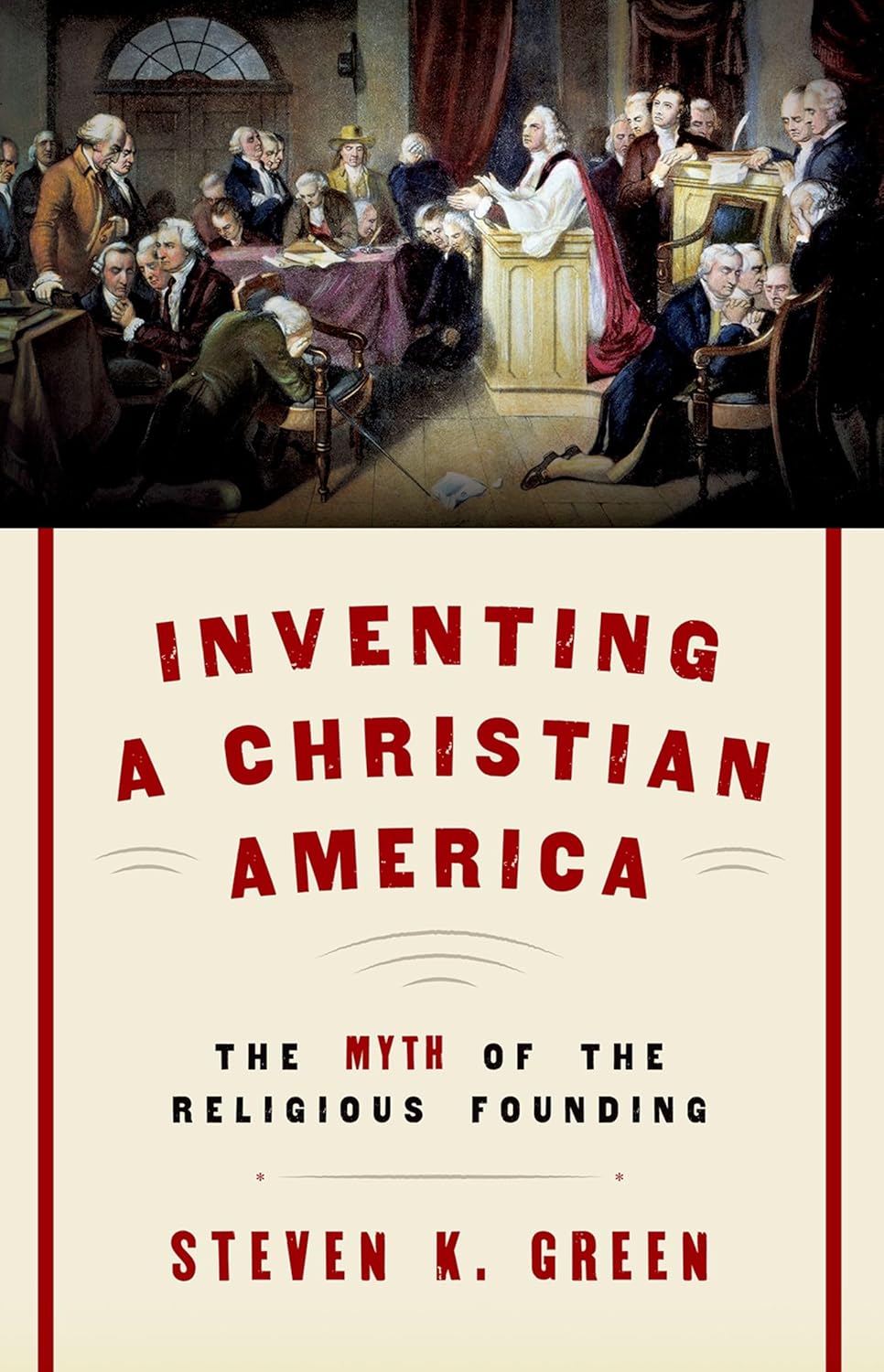
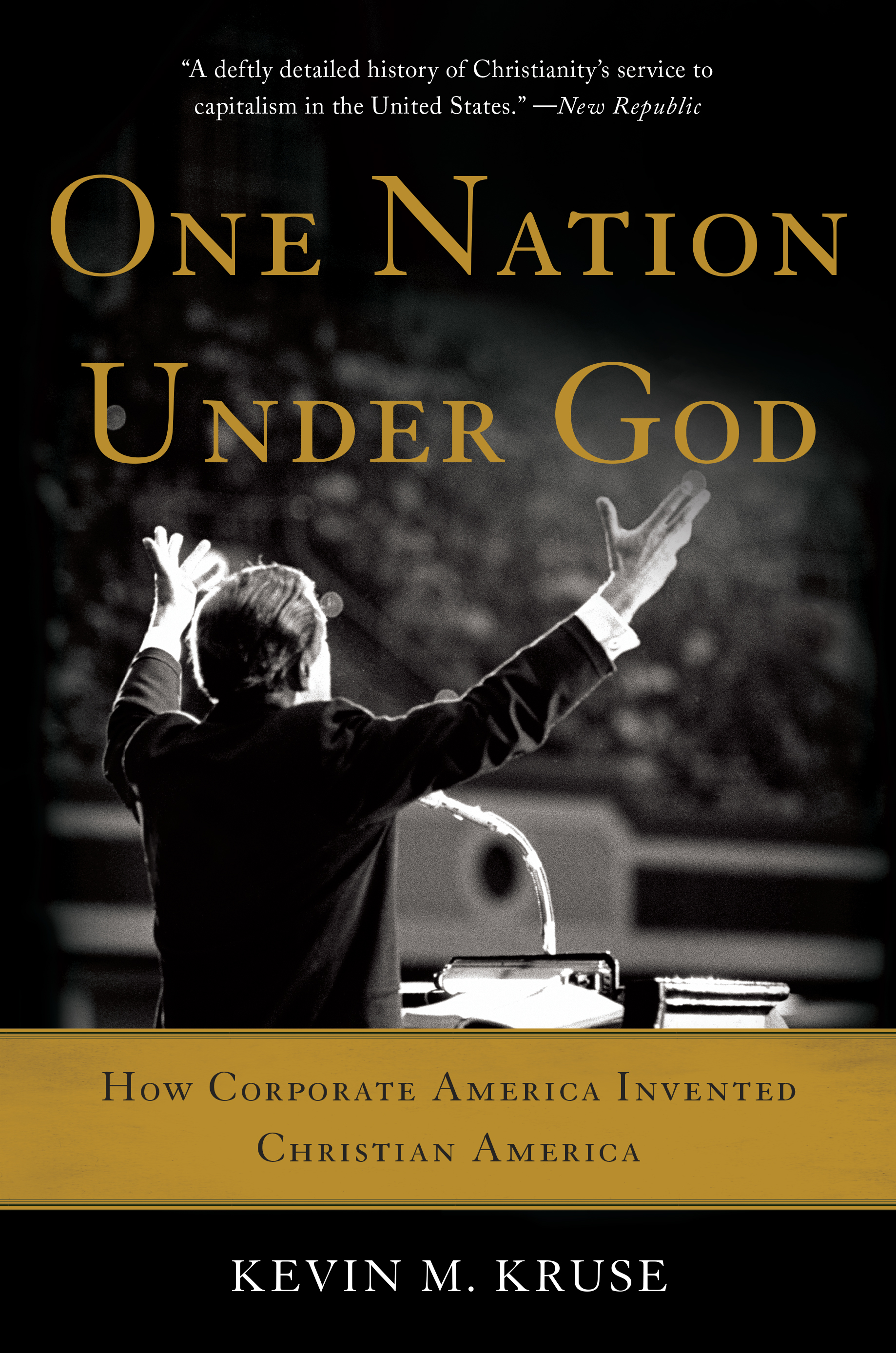
That Americans have disputed who counted as white or who counted as Christian is less important than whether we ever in our foundational documents defined ourselves as a white Christian nation. The idea that Christianity provides, in the words of David Barton’s Wallbuilders, “the moral, religious, and constitutional foundation on which America was built – a foundation which, in recent years, has been seriously attacked and undermined” has few adherents among scholars, but it is popular among evangelicals on the right. Two recent books—Steven Green’s Inventing a Christian America: The Myth of the Religious Founding and Kevin M. Kruse’s One Nation Under God: How Corporate America Invented Christian America—provide devastating critiques of such claims and an intriguing history of the relationship between organized Christianity and the United States.
• • •
Green’s even-handed book takes advocacy of a Christian nation quite seriously, but in the debates of the Constitutional Convention, the speeches and papers of the Founders, and early judicial decisions, he finds little evidence for the Constitution’s biblical grounding. The sources that the Founders cited on behalf of a republican government were overwhelmingly secular. The only reference to the Ten Commandments was in a handful of Sunday closure law decisions, and these died out after the Civil War.
Green offers the conventional interpretation of why the Founders, even the devout among them, created a barrier between church and state: there were too many competing religions. Initially this multiplicity encompassed quarrelling Protestant sects, but things have grown even more contentious since then. First with Catholics and Jews, eventually Muslims, Buddhists, and others, and now large numbers of people who are just uninterested in anything theological.
Green dates the idea of a Christian nation to the Second Great Awakening, which occurred at a time—the antebellum era—when Americans were striving to create a cohesive national identity. Religious competition remained intense, but more and more of the competing denominations were evangelicals who conflated their nationalism and religion in ways that made divine intervention and providential thinking suitable for politics. It was this second American generation, rather than the Founders, who created the myth that has been with us in various forms ever since.
The various forms are important; the original myth is not the same as the one currently in fashion. Both see God’s guiding hand behind the nation’s history and regard Christianity as the basis of republican principles. The old myth, however, was optimistic and tried to be inclusive, which was possible in what was still an overwhelmingly Protestant country. It was oriented toward the future and intent on explaining a providential American destiny. The new myth, by contrast, is sectarian and divisive in a country full of Catholics, Muslims, Jews, Buddhists, etc., not to mention agnostics, atheists, and the sometimes-inchoate mass who define themselves as spiritual. Rather than look to tomorrow, today’s myth appeals to those who think they have lost an ideal past.