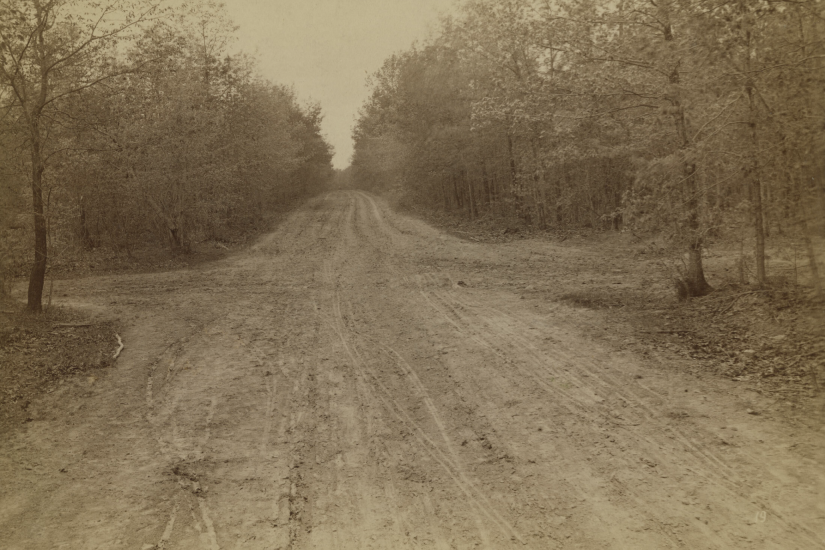
THIS 1887 PHOTOGRAPH shows the intersection of the Orange Plank and Brock Roads in northern central Virginia. It was on and around these roads that, twenty-three years before, Union and Confederate forces fought for two brutal days, May 5–6, 1864.
Seen from the road, the forest rises like a dark wall. This wilderness was known as the Wilderness, which is a name that, like the ghost in Hamlet, simply called the Ghost, is so unclever as to make it oddly elusive—nearly allegorical. A few miles south of Virginia’s Rapidan River, the woods are about halfway between what were then the warring capitals of the North and the South: Washington, D.C., and Richmond. It was a second- and third-growth forest, cleared initially in the early seventeenth century to cultivate tobacco, later to fuel the local ironworks. The thick underbrush was a tangle, covered with shrubs and briars, wild and overgrown, “gnarled, vine-throttled,” in the words of one historian. The war correspondent Charles A. Page, of the New York Daily Tribune, called it a “jungle”; General Ulysses S. Grant, in a dispatch sent during the battle, called it a “dense thicket.” Soldiers who went into this forest, which seemed to hold them as though in a trap or net, had trouble describing it. Some pictures made at the time or in the aftermath lack composition; a sketch by Alfred R. Waud, an illustrator working for Harper’s Weekly, looks like a scribble. Was it the twisted, confused quality of the undergrowth or the horrors of what occurred there that made this forest so hard to represent from inside? It was as if this terrifying place could not be clearly depicted or even seen.
Standing outside it, in the small clearings around Lacy’s Farm or Todd’s Tavern, generals on both sides tried to gain cognizance of what was going on inside, debating with one another the often conflicting reports that emerged. Gordon C. Rhea, who wrote the definitive modern account of this battle, describes how more and more men were “poured” into the forest. It was like a black hole; what went in tended not to come out again. Survivors described how, after entering, they could not follow orders or even proceed in a straight line. They had to duck and curve, clamber and bushwhack. It could take hours to traverse a mile. They quickly lost sight of one another and turned without knowing they had turned; when fired upon, they sometimes did not know whether they were facing their own men or the enemy. Soon after rushing up Orange Plank Road toward the intersection depicted in the accompanying photograph, a leading Confederate general, James Longstreet, was shot by other Confederates; the bullet entered his neck and lodged in his right shoulder.