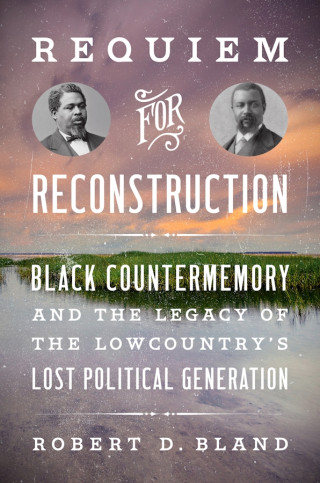
Benjamin Randolph’s funeral serves as one of the first moments where this eulogistic memory was used to provide a forceful defense of Reconstruction’s larger importance in the Black world. In the immediate aftermath of Benjamin Randolph’s assassination, prominent members of the Lowcountry’s political bloc began to deploy Randolph’s death to reconstitute the bonds of the state’s Republican coalition. “He seemed to fully comprehend the fact that our State had been very much broken, the fragments scattered, and to gather them up, and properly unite them, master workmen were required,” lamented northern-born Jonathan Wright. “In every sense of the word, he was a master workman.”
Wright hoped that the Randolph’s legacy would “be felt by generations yet unborn,” a sentiment echoed by many of his Republican colleagues in the legislature. Stephen Swails, a free-born Black New Yorker who had met Randolph in 1864 when both men were stationed in the Lowcountry with different USCT regiments, commented “Senator Randolph is dead, but he still lives in the memories of the Senators who are now here, and his memory will be ever cherished in the hearts of the people of this State.” Another northern-born Republican politician remarked “it is our duty to erect a monument to his memory, not only to mark his resting place, but to commemorate the cause for which he lived and for which he so nobly laid down his life.” Free-born Charlestonian Charles D. Hayne called for a memoriam page in the upcoming issue of the Journal of the House of Representatives of the State of South Carolina.
More than a local or regional story, the effort to produce a Black countermemory of Reconstruction was part of a larger project of Black sectional reconciliation. A wave of new Black newspapers purporting to be truly national in scope and scale, covered the events in the South with close scrutiny. Black journalists forged relationships with Reconstruction-era politicians and traded information to provide the paper’s growing readership with up-to-date political news. Leading editors opined on the actions and events in the South with concern—and at times consternation. In response, a new wave of southern-based Black newspapers emerged in the century’s penultimate decade to confront both the false myths propagated by the white southern press and challenge the whiggish narratives put forth by northern Black leaders about the perceived failures of Black southerners in acquiescing to the New South political order and abandoning Reconstruction.

A.M.E. Metropolitan Church, Washington, D.C., Library of Congress, 1900