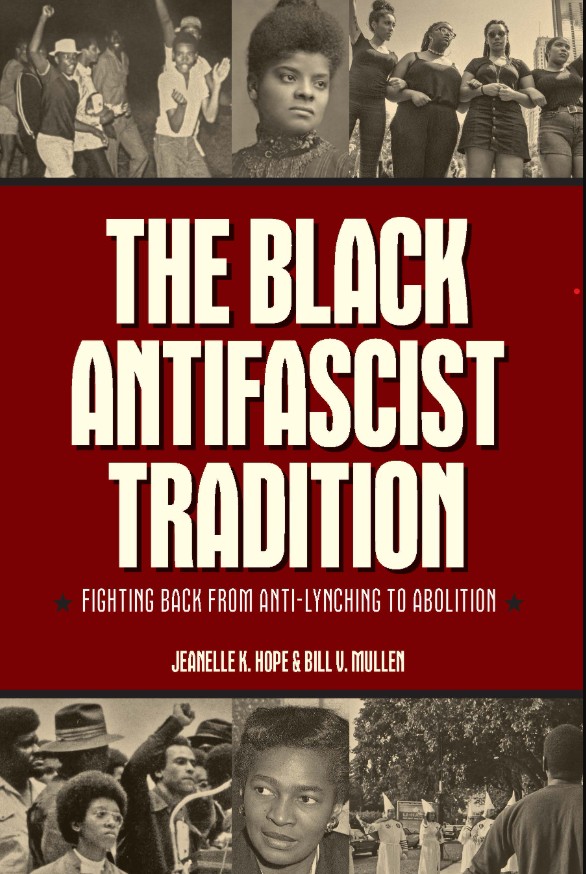
It is important to historically situate the phenomenon of fascism, especially within our contemporary context where the Constitution is being trampled upon, and what one might call the paramilitary deployment of Immigration and Customs Enforcement (ICE). Your book, The Black Antifascist Tradition: Fighting Back from Anti-Lynching to Abolition, which you co-authored with Bill V. Mullen, powerfully challenges the narrative that fascism is a phenomenon that is exclusive to 20th-century Europe. In this regard, your book constitutes a necessary counter-narrative that highlights the gratuitous violent history that Black people in the U.S. have faced since their enslavement. This counter-narrative is what you term the Black anti-fascist tradition. In brief, what are some of the features that define the Black anti-fascist tradition?
The Black anti-fascist tradition recognizes that there has been a long arc of fascism throughout history, and that anti-Blackness has long undergirded fascist policies and formations, thus, disrupting prevailing historical narratives and theorizing on fascism. We argue that the earliest roots (or pillars) of fascism — authoritarian rule, genocide and ethnic cleansing, militarism, racial capitalism, dual application of the law — can be traced to the colonization of Africa and chattel slavery across the Americas. One of the most salient and defining features of anti-Black fascism is genocide. We chart out the systematic genocide of Black people from the brutality of enslavement, post-emancipation lynchings, to state-sanctioned violence and police brutality. Ida B. Wells’s Southern Horrors and Red Record, W.E.B. Du Bois’s lynching reports in The Crisis, William Patterson’s petition to the United Nations entitled, “We Charge Genocide,” and Arlene Eisen’s 2012 report “Operation Ghetto Storm” all meticulously document the impact of lynchings and the immiseration of Black life. And with such damming evidence in hand, they argued that such acts constitute genocide. Indeed, “We Charge Genocide” emerges as a cross-generation rallying cry among Black anti-fascists like Patterson, Stokely Carmichael, and the Chicago-based youth group aptly named “We Charge Genocide.”
Beyond presenting this counter-narrative, so much of our book also names how Black people have been on the front lines of anti-fascist struggles in Europe (the Spanish Civil War), Ethiopia (the Italian invasion of Ethiopia), and across the United States. Moreover, the Black anti-fascist tradition underscores that fascism attacks on multiple fronts (i.e., art and cultural production, education, immigration, law and policy, health care, housing, etc.) and subsequently, requires a multifaceted resistance. Black anti-fascists have incorporated various organizing strategies, tactics, and actions including legal challenges, mutual aid, anarchy, autonomy, self-defense, boycotts, solidarity, and abolition.