During World War II, President Franklin D. Roosevelt’s administration made what may well be the nation’s most explicit and pernicious attempt to demand loyalty. In 1942, roughly two months after Pearl Harbor, the government began to detain Japanese and Japanese American residents of the West Coast and Hawaii. Eventually, some 120,000 people, two-thirds of whom were American citizens, were imprisoned in large inland camps. During their detainment, which lasted up to four years, internees had to take a survey that, among other things, asked whether they would serve in the Army “on combat duty, wherever ordered” and “swear unqualified allegiance to the United States of America”—that is, to the country that had just imprisoned them, presuming their disloyalty. If Loyalty Day is uninteresting because it’s artificial, then this was something far more sinister. For many internees, the so-called loyalty questions seemed like a threat.
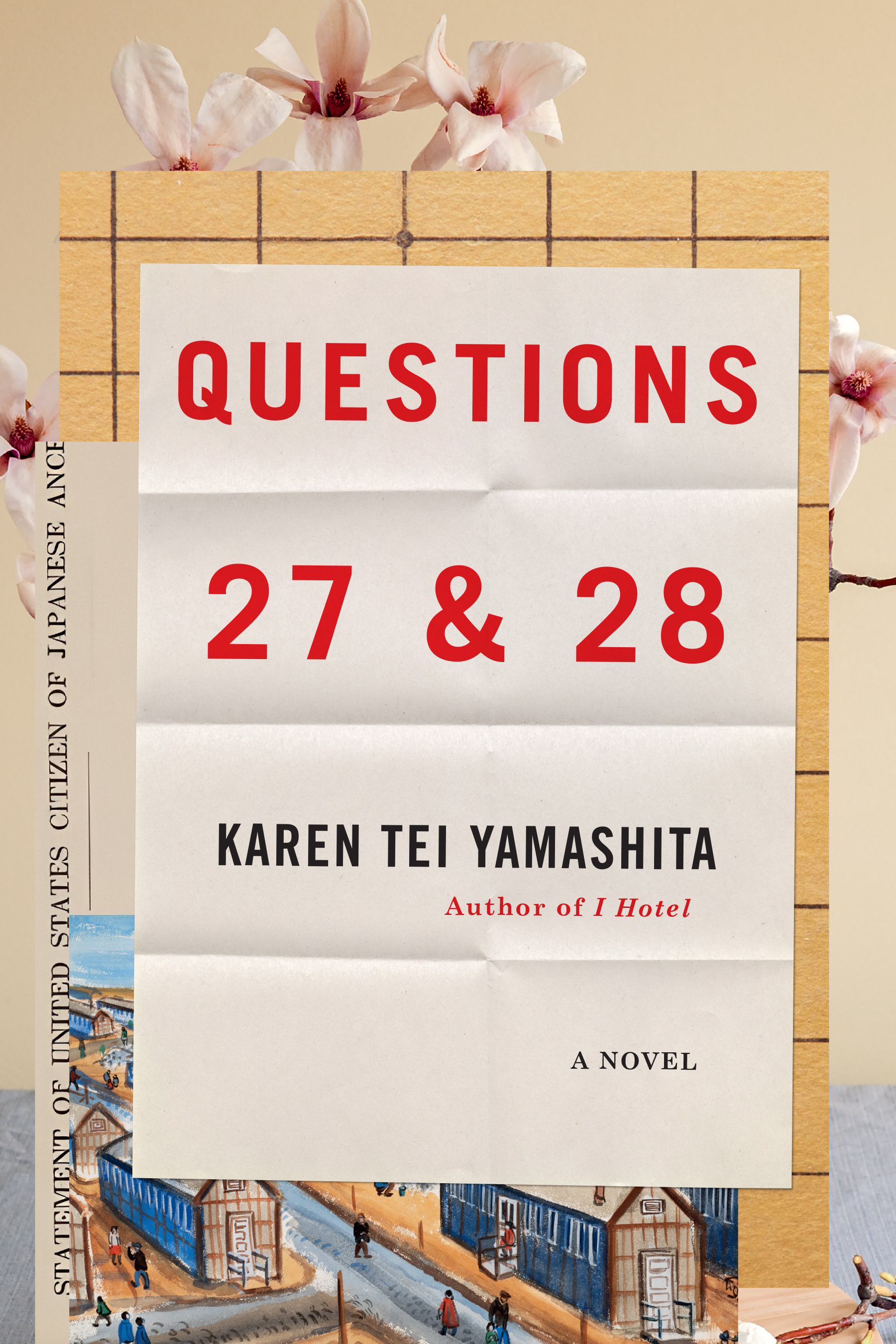
Questions 27 & 28, the author Karen Tei Yamashita’s tenth book, gets its title from those loaded questions. The novel roves through time, space, and literary styles to tell stories of many Japanese immigrants and their descendants in the United States. She brings to life nearly 100 people who were interned—or their ancestors were, or their children, or their legal clients, or a wide range of other connections. All of these stories merge into a sprawling exploration of what it was like to have to answer the loyalty questions, and how those questions echo through American history to this day. Crucially, Yamashita does this without ever legitimizing the test itself. “Those questions,” she writes, “that damned questionnaire, are meaningless, but the consequences of interpreting them, choosing yes or no, shape the future.”
In a sense, Yamashita is the future to which she refers: Her parents were both interned. She also brings a scholarly perspective to her subject; before becoming a novelist, she spent nearly a decade researching the history and anthropology of Japanese communities in Brazil. Many of her novels mix this academic training with an experimental, playful sensibility. In her 2010 National Book Award finalist, I Hotel, an account of Asian American organizing in San Francisco from 1968 to 1977, she constantly switches forms and characters while remaining grounded in her study of real activists. In Questions 27 & 28, she goes a step further, collaging archival material related to the internment camps into her own richly creative writing.