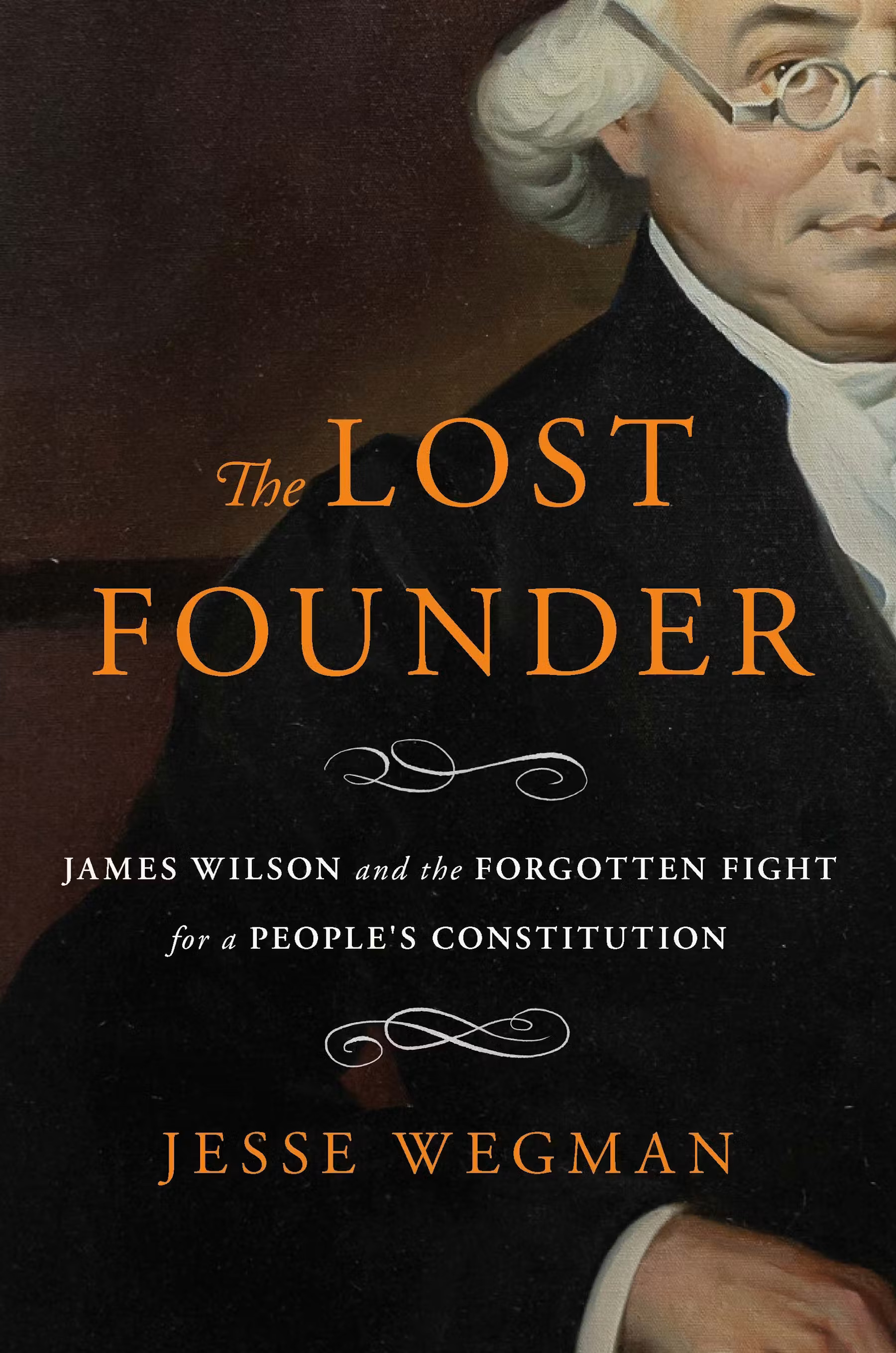
In the book, Wegman explains how Wilson’s life informed his ideas. Born in Scotland during the Scottish Enlightenment, Wilson grew up in a society that exposed him to democratic institutions: His Presbyterian upbringing familiarized him with a church structure in which ordinary members participated in governance, and Scotland’s educational system exposed even poor children to literacy and intellectual life. Wegman argues persuasively that these experiences shaped Wilson’s lifelong conviction that ordinary people should participate in the institutions that govern their lives. That conviction became the central theme of his political philosophy, one that Wegman dwells on throughout the book.
The clearest expression of that belief came in Wilson’s most important decision during his short tenure on the Supreme Court: Chisholm v. Georgia. There, Wilson confronted a question that still resonates today: Could a state be sued by a citizen of another state, or did that state’s inherent sovereignty shield it from liability? Wilson’s answer was straightforward: Because in America there are “citizens, but no subjects,” states could not claim the kind of immunity once claimed by kings. Just as a state could sue a citizen, or a state could sue another state, so too could a citizen of one state sue a different state.
But states were not thrilled with the idea of being hauled into court, and so shortly after, Congress proposed (and the states ratified) the 11th Amendment, which stripped federal courts of jurisdiction over such suits. Over the years, that amendment has been interpreted as barring a far broader range of lawsuits against states than its text suggests. Wilson’s greatest judicial opinion was wiped away almost as quickly as it was written.
Wilson himself fared little better. The same man who helped design the architecture of American government became consumed by land speculation and accumulated extraordinary debts. He became the first and only justice to be imprisoned while on the bench, and he died sick with malaria while on the run from creditors. Wegman told me that by then, many of Wilson’s contemporaries were simply “sick of him.” It is a remarkable ending for a man who had helped alter the course of American history.
The book is a fascinating historical tale, full of interesting behind-the-scenes moments related to the drafting and passage of the Constitution. But there is one respect in which I wished the book had gone further. Wegman is at his strongest when tracing Wilson’s revolutionary insight that sovereignty resides in the people rather than in kings, aristocracies, legislatures, or governments. That idea allowed the colonists to make a far more radical claim than merely objecting to taxation without representation. If sovereignty resided in the people, Parliament did not merely lack authority to impose certain taxes, it lacked authority over the colonists altogether. The American Revolution was therefore not simply a dispute over representation; it was a dispute over the source of political authority itself.