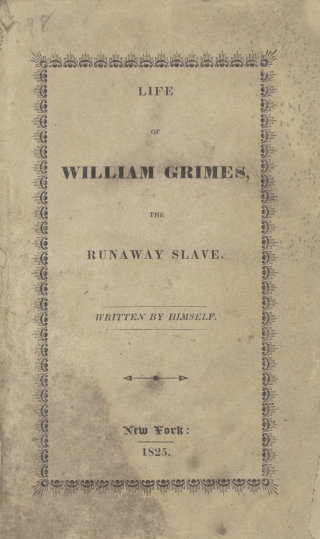
In 1825, Life of William Grimes, the Runaway Slave, Written by Himself became the first known fugitive-slave narrative in American history. Although earlier autobiographical accounts of slavery had been published in England, the genre wouldn’t fully flourish in the United States until the antislavery movement of the 1830s to 1860s, when such narratives became powerful tools of moral persuasion, exposing the brutality of bondage while asserting the writer’s humanity, intellect, and will. William Grimes wrote before that moment, introducing a distinctly American voice shaped by the horrors of enslavement in the South and the precariousness of freedom in the North. What he published was more than a memoir—it was an indictment of the contradictions that had been central to the American experiment since the Revolution itself.
For 30 years, I have been researching the life and legacy of Grimes, who was my third great-grandfather. In May 2024, during my final week as a research fellow at Yale’s Beinecke Library, I made a trip to the Boston Athenaeum to see a copy of his book that had been housed there since 1849 and remained unexamined by scholars for 175 years. This copy, I’d learned, had been addressed to President John Quincy Adams. I had no way of knowing whether the sixth president had read Grimes’s narrative. But discovering the fact that Grimes had wanted him to see it moved me in ways I hadn’t anticipated.
Grimes’s story opens with bitter irony:
I was born in the year 1784 in J_____, County of King George, Virginia, in a land boasting its freedom and under a government whose motto is Liberty and Equality. I was yet born a slave.
“In all the Slave States,” Grimes wrote, “the children follow the condition of their mother.” Though his father, Benjamin Grymes Jr., was a wealthy white Virginia planter, William remained enslaved like his mother—legally the property of a man he calls Dr. Stuart, Grymes’s neighbor. He recalled carrying newspapers to his father, who would speak and laugh with him and send him to the kitchen for something to eat. Whatever endearment young William may have felt, Benjamin Grymes neither owned, purchased, nor freed his enslaved son.
At 10 years old, William was sold by Dr. Stuart to Colonel William Thornton, his brother-in-law, and sent to a distant plantation in what is now Rappahannock County. He grew up, as he later wrote, friendless and motherless, shaped early by violence and hunger. Inside the house, the head servant and seamstress sabotaged him to advance her own child; in the fields, overseers beat him for the slightest offense. When he was 12 or 13, he ran away to escape a brutal overseer, hiding in a hollow log for three days until he gave himself up, deciding that he “might as well be whipped to death as to starve.” Hardened by slavery, he grew up defiant.