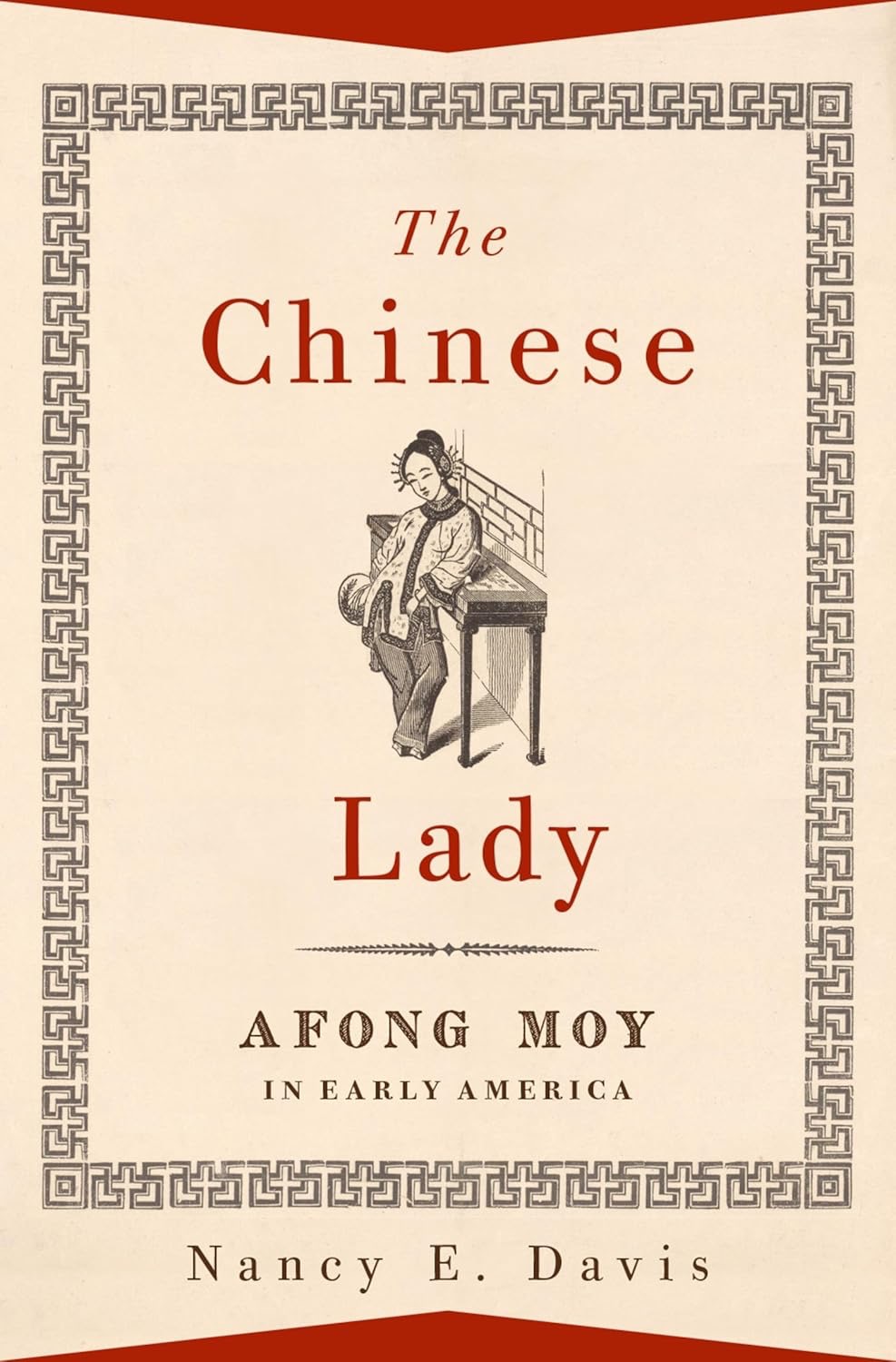
During the 17 years of Afong Moy’s visible presence in America, her treatment as a Chinese woman varied over time. When she first arrived, the public generally responded to China in a positive way. On the edge of patrician orientalism, the perceived “Orient” was one of exoticism, beauty, dignity, and revered history. The Carnes merchants, Francis and Nathaniel G., and the ship captain Benjamin Obear, who brought Afong Moy to America, took advantage of this perception, using the sensual stimulus that came from marketing China trade goods with an exotic. They played on, controlled, and mediated the public’s consciousness of her visual difference—her bound feet, Chinese clothing, and accessories—all to promote their goods.
In the second phase of her experience in the later 1830s, Afong Moy made a transition from a promoter of goods to that of spectacle. During this time, she experienced the conjoining of two worlds—that of the market and the theater. Afong Moy operated simultaneously as entertainment, edification, and billboard. Her new manager occasionally set her against a panoramic backdrop of an illusionistic oriental scene, thus highlighting her cultural exceptionality through her clothing, objects, and images.
Afong Moy’s arrival in a period of great upheaval in American cultural and economic life placed her in the crosshairs of slavery, Native American removal, the moral reform movement, and ambivalent attitudes toward women. On her three-year journey from 1834 to 1837 throughout the mid-Atlantic, New England, the South, Cuba, and up the Mississippi River, her race provided an occasion for ridicule, jingoism, religious proselytizing, and paternalistic control.
After a heart-rending, eight-year interregnum out of the public eye, Afong Moy once again took to the stage in the late 1840s and early 1850s. P. T. Barnum, the master marketer of difference, became her manager. He recognized her promotional value as the only Chinese woman in America whose bound feet, clothing, objects, and experience signified an “orientalist” presence that might titillate the American public. Afong Moy’s time in America provided an additional benefit to Barnum: she no longer needed an interlocutor. Though occasionally she required an interpreter, her language skills were likely sufficient for most audience interactions. On stage she provided evidences of her dissimilarity from the use of chopsticks to the demonstration and explication of Chinese religious rituals.
Yet with the passage of time, and with new views of China made possible with the opening of four additional Chinese ports in the later 1840s, public sentiment regarding China had become less accepting. Derisive and mocking commentary in the press and on Afong Moy’s presentation on the stage became more prevalent. The public began to form stereotypical views of the Chinese as backward, arbitrary, undemocratic, and sometimes cruel. The classification and designation of “types” of peoples by scientists and philosophers lent credence to this view. Promoters and commentators associated negative characterizations of the Chinese with Afong Moy: a woman, an “oriental,” and a performer on the stage.