Cauleen Smith recently encountered a terrifying specter. A spirit appeared to her portending a divine promise, like a biblical angel to Mary or the prophets. The spirit was of a white woman in billowing robes, her hair tied in a chignon. And she said that God—God Almighty Himself—will descend from the heavens to the earth and vindicate the Confederate States of America. The rebel nation’s white supremacy will be magnified. Its racial violence will be justified. It will be retrospectively acquitted in the living memory of the world. Its policies will rise. A new dispensation will come.
Smith, a multimedia artist who works primarily with video, took such a chilling warning seriously. “Vigilance is necessary against white supremacy,” she said. If God’s radical appearance on behalf of the rebels were truly imminent, we needed to get moving.
So she assembled lights around the spirit, and focused a camera on her raised right hand, which pointed toward the sky to iterate her message. Then Smith settled in to watch the surveillance feed. Her eyes fixed on that bone-white hand where God would return. She watched and waited. He’d be coming. Any minute.
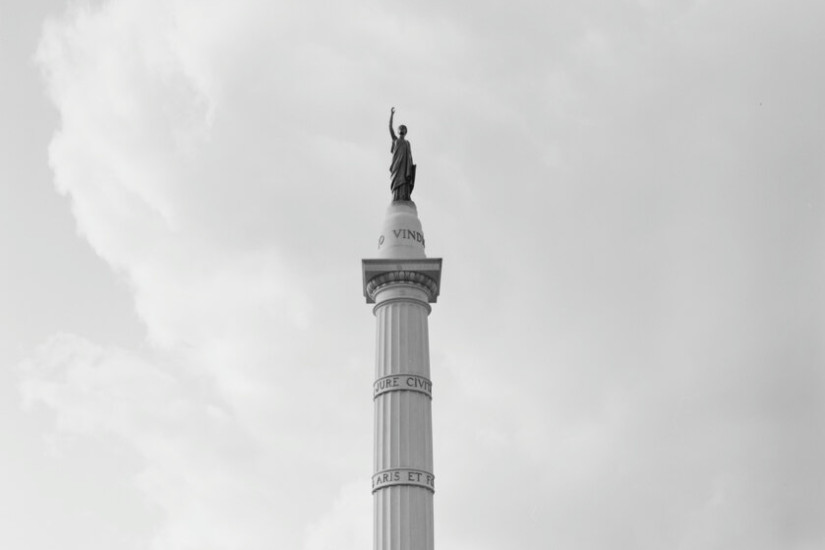
Smith’s piece—the lights, camera, hand—is an installation that debuted last October at the Museum of Contemporary Art, or MOCA, in Los Angeles. This female “spirit” is a bronze Confederate statue titled Vindicatrix, a reference to “Deo Vindice,” the Confederacy’s official motto. It translates God will vindicate. She once topped a towering Doric column that dominated the Jefferson Davis Memorial in Richmond, Virginia, which was dedicated in 1907 on the Confederate president’s birthday, a day celebrated as Confederate Memorial Day.
Vindicatrix is serene with expectation, wielding a shield engraved with the battle flag. She is one of very few Confederate statues to depict a woman, an allegory of the rebels’ religious, racial, and, as Smith put it, “libidinal” values, earning her the nickname of “Miss Confederacy.” She was also considered the representation of the “spirit of the South,” and she is one of 10 decommissioned memorials now on display in “Monuments,” a groundbreaking exhibition by MOCA and The Brick, a visual arts space not far from Hollywood, that interrogates how Confederate imagery perpetuates the idea of American white supremacy. Its opening coincided with the tenth anniversary of the nation’s heightened reckoning with Confederate iconography, a reckoning that has left communities grappling with the fates of their statues, which enjoy the protections of not only their defenders but, in many cases, the law. The show is the first large-scale interjection in the debate over where these symbols belong in America’s landscapes; by juxtaposing them with art, “Monuments” invites us to consider the statues beyond the binary of take them down or leave them up.