American drug abuse in the twenty first century has been largely defined by the opioid crisis that affected large parts of the nation beginning in the late 1990s and extending to our current moment. Books such as Pain Killer: A Wonder Drug’s Trail of Addiction and Death (2003) by Barry Meier (republished in an expanded addition in 2018 as Pain Killer: An Empire of Deceit and the Origins of America’s Opioid Epidemic), Empire of Pain: The Secret History of the Sackler Family (2021) by Patrick Keefe, and Beth Macy’s Dopesick: Dealers, Doctors, and the Drug Company that Addicted America (2018) captured how the opioid crisis unfolded and the tragedy that ensued. Television shows based on these works, such as Dopesick (2021) and Painkiller (2023), depicted this history for viewers on the streaming services of Hulu and Netflix.
Although valuable, these works focused less on the long history of opioid drug treatment and more on the immediate threat. Historians such as David Courtwright, David Musto, and Claire D. Clark, among others, have explored this longer history in a more academic form with greater attention to its history.
Yet, the most popular works on the topic of drug addiction treatment and most influential have been documented by journalists. For example, Michael Massing’s 1998 The Fix juxtaposed the attempt to treat addicts during the crack epidemic of the late 1980s and early 90s with earlier efforts of the 1970s, led by the Nixon administration’s Special Action Office for Drug Abuse Prevention (SAODAP), which Massing believed “could serve as a model for the nation today.” Published in 1998, Massing could not foresee the last three decades of opioid addiction as it ruthlessly spread through prescription drugs.
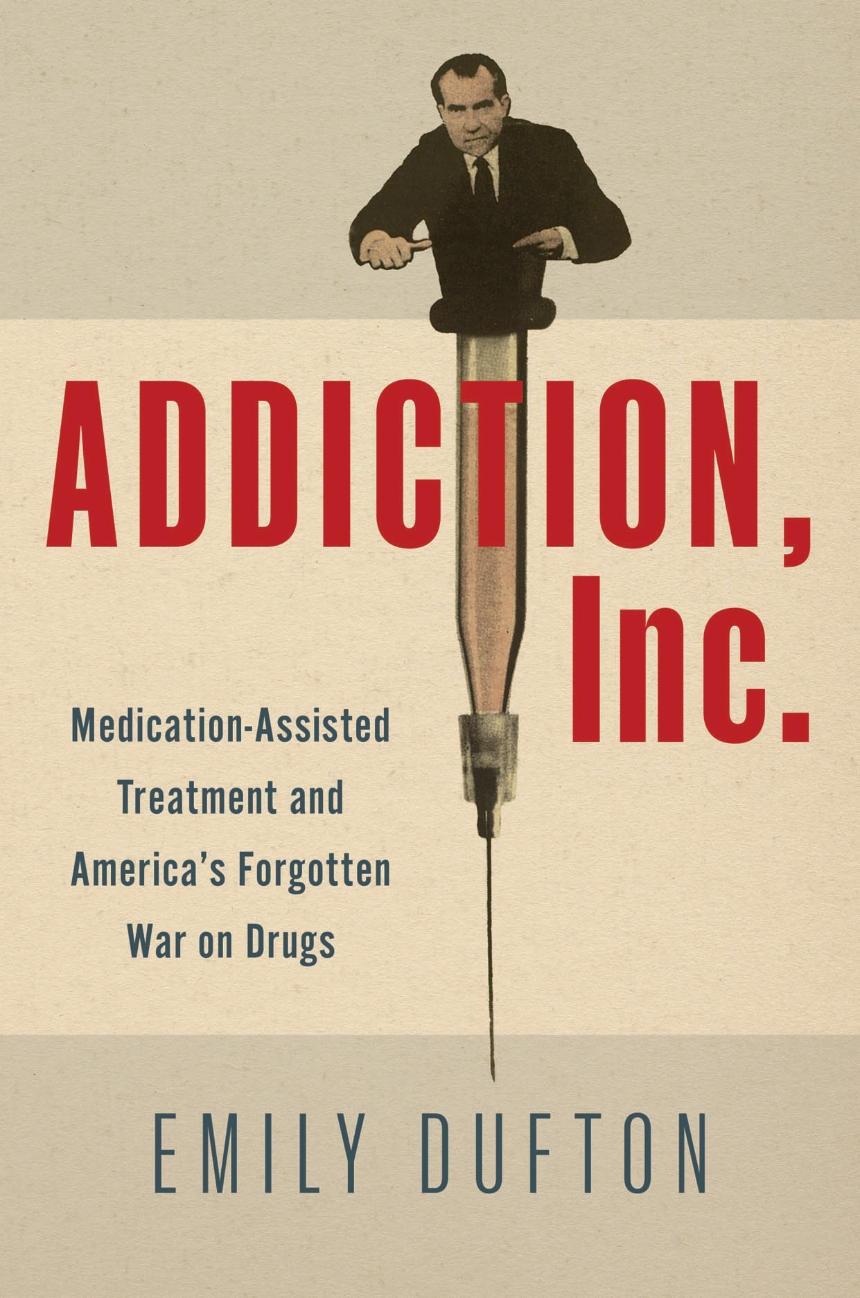
Into this historiographical blind spot comes Emily Dufton’s Addiction, Inc: Medication-Assisted Treatment and America’s Forgotten War on Drugs, in which she provides an update on this history exploring the arc of treatment for opioid addiction from the late 1960s to the present, arguing that, briefly during the early 1970s, the federal government provided real treatment for opioid addicts, referred to as Methadone Maintenance Treatment (MMT). After this brief flowering, the government abandoned this approach for a free-market orientation that established treatments beyond MMT, changing the acronym to “Medication Assistance Treatment” (MAT) and later Medications for Opioid Use Disorder (MOUD). This represented changes in policy as treatment split into a two-track process which delivered “commercial success”, but ultimately failed to serve patients adequately and signaled class and racial differences for recovering addicts.