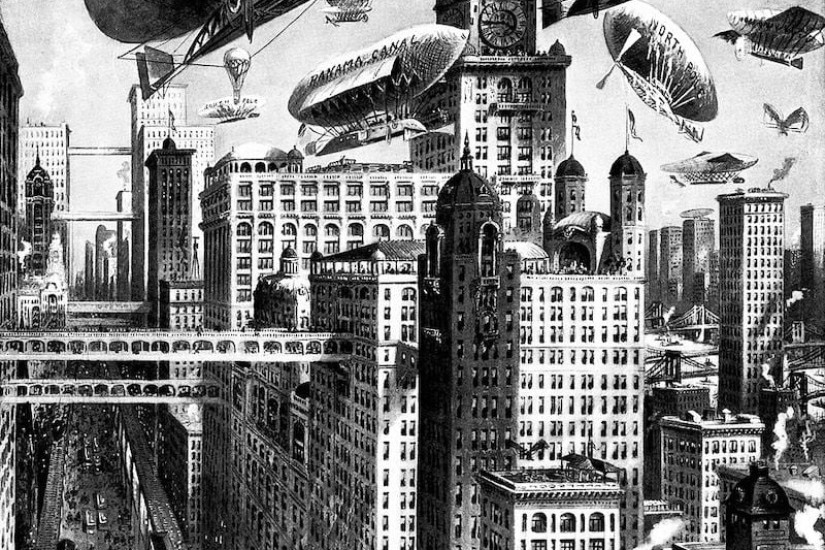
Typically, these futuristic illustrations showed an urban landscape in the background. Skylines were invariably dense and dotted with high-rise buildings. Chicago’s sleek monorail represented what was to come. Behind it, we see buildings of the present. Down below, there are streets choked in traffic. This was part of a pattern. The implication seems to be that private cars do not belong in the future. Even the language of “horsepower” placed them in the lineage of obsolete predecessors. Cars were just too inefficient to meet the demands of modern cities. Unlike the suspended monorail, capable of moving more people while taking up far less space, they could not be reconciled with the dense, vibrant streetscapes of tomorrow.
It really could be easier to imagine flight as a realistic alternative. In the imagined Buenos Aires of 2177 that would blow away Jules Verne, mass transit was widespread while cars had fallen into disuse.
Though some of these ideas might have been far-fetched, most major metropolitan areas had ambitious plans to extend mass transit in the 1910s. Even in smaller towns in the United States, people assumed that in the future transportation would be moved to the skies or underground. An article on New York “a century hence” claimed that each avenue in Manhattan would “undoubtedly” have a subway running beneath. Certainties aside, several projects to build new subway and rail lines were postponed during World War I, shelved after the Great Depression hit, and abandoned once highways took over. Due to the early rise of car ownership, urbanization in the United States had already begun to deviate from other places. The number of passenger vehicles in the country grew at an astonishing rate, from 5 per 1,000 people in 1910 to 187 in 1930. This meant that around half of families owned a car. Most major European countries would only reach comparable numbers in the 1960s and 1970s; Argentina, Mexico, and Brazil, in the 2000s; China, India, and South Africa, in the 2010s.
The victory of the car in the United States and later much of the world was by no means inevitable, or even predictable. In the beginning of the century, cities still relied heavily on horse-led streetcars. This ended in New York City by the late 1890s, and in Paris by World War I. Electric streetcars moved about twice as fast, but also needed track systems. In the late 19th century, bicycles represented a rupture: they allied freedom of movement with efficiency.