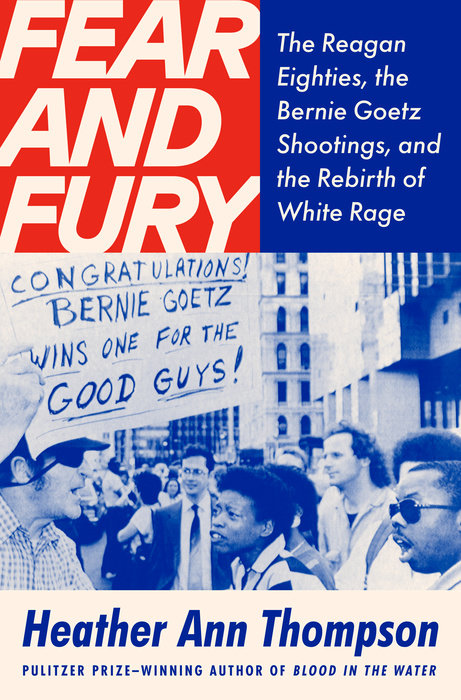

Two recently published books from Penguin, Heather Ann Thompson’s Fear and Fury and Elliot Williams’s Five Bullets revisit the Goetz shootings and the trial. Thompson is a historian and the Pulitzer Prize-winning author of Blood in the Water, a history of the Attica prison uprising, and Williams is a legal analyst at CNN who worked extensively in law enforcement and legislative affairs for Democratic Party politicians and administrations (he served as a political appointee in the Obama administration for eight years).
Despite their topical overlap, the two books take vastly different interpretive approaches. Williams suffers from an amateurish incuriosity that denudes the story of its politics and reproduces the racialized frame that characterized the outcome of the case at the time. Thompson, meanwhile, takes a more scholarly and principled approach by using the Goetz case to make probing insights into the nature of racial capitalism in eighties-era New York City and the post-Civil Rights American state. Even Thompson’s book, though, suffers from a misguided (and indecorously sales-oriented) desire to contort the Goetz history into a parable about Trump and the right, irresponsibly obscuring the role of liberalism and policymaking in fueling the event’s noxious racial politics.
Williams’s account refuses a serious analysis of the racism that motivated Goetz’s crime and his acquittal, instead approaching Goetz’s anti-black vigilante terror and the U.S. legal system’s ratification of such violence as a flattening—and obfuscatory—commentary on “human nature.” In so doing, his analysis tends to justify the system that allowed Goetz to evade consequences, ultimately concluding that the case offers “an example of the system working,” even if he grants that “the fact that a legal outcome is supportable and sound isn’t everything.”
Take, for example, when he essentially defends the presiding judge’s decision to forbid race from being directly “addressed” during the trial. This jarring move, which had the effect of exculpating Goetz was, according to Williams, an act of “caution” that was “not misplaced.” “No matter how much the city’s racial tension was a staple on the nightly news, the case was, at least on paper, about whether one man’s fear was legitimate enough for him to open fire on people he felt were about to harm him,” Williams writes. Williams’s refusal to question the political foundations of a system that encourages the excision of race in a case where racism clearly permeated both the shootings and the trial itself reproduces the white supremacist fable of race-neutrality that led to Goetz’s shocking acquittal. Indeed, this impulse to neutralize systemic racial bias is the same tortured logic that led jurors to insist that their decision to acquit Goetz—a man who confessed on tape his intention to kill the boys—was unrelated to race.