The authors of The Scarlet Letter, Moby-Dick, Walden, and Leaves of Grass at times embraced, at times resisted Emerson. What they could not do was ignore him. Hawthorne was drawn to Concord even as he satirized it. Melville, reading Emerson’s two essay collections in the 1860s, scribbled a mix of agreement and strong disagreement in their margins.
In the 1850s, all four writers were in their thirties or forties. Each developed a voice, a framing, and a structure that were unique in Anglo-American literature. To be sure, a full accounting of the American Renaissance would include Edgar Allan Poe and Emily Dickinson, two writers who were more distant from Emerson and his circle (though Dickinson did admire his poetry). Poe’s works mostly dated from the 1840s, and Dickinson’s then-unpublished poems are mostly from the 1860s. Yet it is the four great books of the 1850s that are an outgrowth from and a response to Emerson, with revealing backstories behind their creation.
The Scarlet Letter
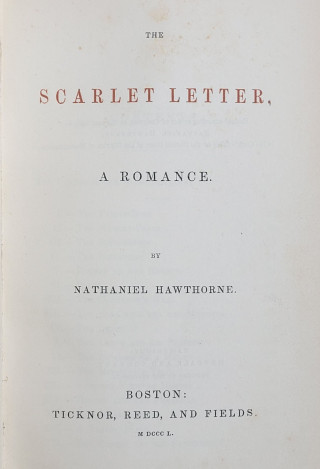
Nathaniel Hawthorne, on the evidence of his novels, found it difficult to follow Poe’s advice to “cut Mr. Alcott [and] hang (if possible) the editor of The Dial.” He wrote three novels in quick succession in the early 1850s, two of which feature contemporary reformers. The Scarlet Letter is the only one of Hawthorne’s mature novels that avoids any hint of the Newness.
Hawthorne was the opposite of Emerson. His tragic worldview clashed with Emerson’s idealism, which may explain why he so often wrote stories that undercut the best of reformers’ intentions with the flaws of their hearts. In The Scarlet Letter, he turned to the seventeenth-century setting of Puritan Boston. Rather than the strange “moral shapes of men” that he satirized elsewhere, the characters in his great-est book face a rigid and restrictive social order. Their flawed hearts thereby become far more dangerous.
When eighteen-year-old Louisa May Alcott noted that she was reading Hawthorne, she commented that “‘The Scarlet Letter’ is my favorite . . . I fancy ‘lurid’ things, if true and strong also.” Poe’s advice may have been wise: by getting Emerson out of his head, Hawthorne freed himself to write his most enduring work.