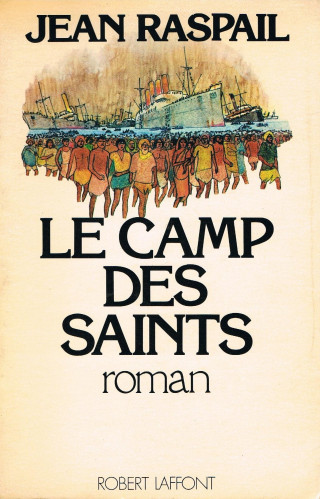
The Camp of the Saints imagines a future when the overpopulated Third World, represented by the streets of Calcutta, sets sail in a makeshift flotilla for the Côte d’Azur. This million-person mass threatens to overwhelm the West in human (really subhuman) misery. As Jeffrey Hart put it in a positive review of the English translation: “Raspail brings his reader to the surprising conclusion that killing a million or so starving refugees from India would be a supreme act of individual sanity and cultural health.” He “is to genocide what Lawrence was to sex.” In his telling, feckless leaders, ruined by liberalism, commit cultural suicide – led in part by the Catholic hierarchy. In the end, bien-pensant humanitarianism proves overwhelming and the West, we presume, falls. The book was a genuine controversy and a hit. It has sold something like half a million copies and received an immediate English translation through Scribner’s.
Generously, Raspail’s vision is a parable about civilizational values that carelessly posits suffering refugees as unwitting modern-day Visigoths, holding them up as a mirror to reveal Western man’s loss of faith in his own civilization. Less generously, it’s a racist screed that equates civilization with whiteness.
From Twitter anons to the White House, Raspail and Camp of the Saints have adherents. He and the book are lauded for their prescience and clarity of vision. “Before anyone else, Raspail foresaw the ‘Great Replacement’ of Europe’s peoples by their counterparts from the Global South,” writes Éric Zemmour. “He said it, wrote it, foretold it. But Cassandra is never believed.” The upshot, certainly, is that for Western Civilization to survive, immigrants must be repelled – and perhaps purged – and liberals (beholden to the ideology of Western suicide) must be crushed. Raspail is the useable sage for the makers of “Defend the Homeland” memes and policy.
Unsurprisingly, a new English edition has recently been published for the postliberal audience, complete with an introduction by Raspail-enthusiast Nathan Pinkoski. The noxious Pierre-Emmanuel Gobry praised it in the Claremont Institute’s American Mind. The article is winkingly headlined “The Great Reprinting” and calls it “required reading,” especially in what Gobry calls “the era of the Great Replacement.”
Gobry says interest in Camp of the Saints revived in the 2010s. Perhaps in his native France where Raspail was a controversial but nonetheless celebrated writer. The book has also had a secret half-life on the American Right. I don’t mean the overtly white nationalist Right, either, with its Turner Diaries and other bibliotheca. Rather, The Camp of the Saints became a minor touchstone, a cliché, and an appeal to sagely authority among the traditionalists and immigration restrictionists in the conservative and paleoconservative worlds.