Gerard O’Neill was used to seeing the world from above. During the weekends, the Princeton professor spent his time flying over northwest New Jersey in a glider. From that height you can make out a patchwork of corn, soy, and horse pasture framed by dark trees and winding roads. You might see rectangular fields punctuated by smatterings of ponds, or clusters of suburban cul-de-sacs surrounded on all sides by long stretches of green.
Born in Brooklyn in 1927, O’Neill joined the US Navy as a radar technician immediately after high school, finding himself deployed to the Pacific theater before World War II drew to a close. After swapping his uniform for civilian dress, O’Neill studied physics and mathematics at Swarthmore College and Cornell University. He eventually landed a professorship at Princeton, where he built one of the first colliding beam storage rings, a system that paved the way for famous descendants like CERN’s Large Hadron Collider.
In 1965, NASA opened the astronaut corps to scientists, and O’Neill threw his hat in the ring. He passed the early tests but was cut before the final list. With space out of reach, O’Neill settled for the next best thing: taking to the sky as a glider pilot on the weekends and teaching during the week. A few years later, he was still thinking about humanity’s place in the stars as he worked on methods to beam electricity to Earth via space-based solar power. One day in the classroom, wondering about whether other industries might migrate to space, he scribbled a question on the blackboard: “Is the surface of a planet really the right place for expanding technological civilization?”
That thought experiment found institutional backing thanks to Hans Mark, the director of NASA’s Ames Research Center. In 1975, Mark funded a 10-week summer faculty fellowship that included 19 professors, six students, and three volunteers. Their brief was to determine whether it was possible to build “settlements” on the final frontier. O’Neill served as technical director.
NASA had begun thinking about crewed exploration outposts as early as 1969, when its post-Apollo plan envisaged a program that included space stations, a lunar surface base, and a later Mars expedition. But in each case, NASA looked to stations and bases as mission infrastructure rather than self-sufficient civilian settlements.
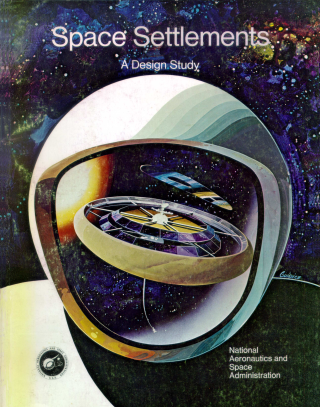
The result of the fellowship, published in 1977 as Space Settlements: A Design Study, is a beautiful thing to look at. The illustrations feature shimmering aluminum surrounded by purple-hued nebulae, inky shuttle silhouettes and spacewalking astronauts, and pages of graphs and diagrams to emphasize the mathematical rigor behind what was an ambitious vision for the future.