Over the past fifty years, white Christians have shifted decisively to the right. That shift is not isolated to white evangelicals (which most people know about), but is also evident among white Catholics. Increasingly, to be white and Christian is to support the Republican Party.
That was not always the case. For younger adults, it can be difficult to imagine a religious world that was not dominated by the religious right. However, if we take a peek at the partisan composition of white Christians in 1972, as far back as we can go, we see a different political landscape.
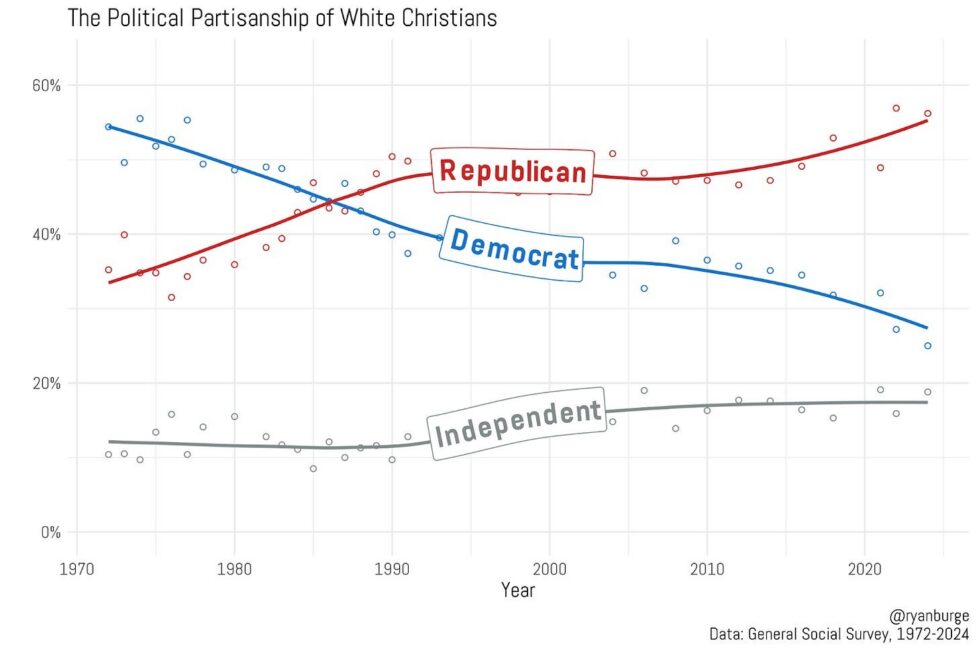
In 1972, a clear majority of white Christians, regardless of their denominational affiliation, were Democrats. To contemporary audiences, that finding is often surprising. It is important to note, however, that these were not Democrats in the modern sense. Many were Southern Democrats (often called Dixiecrats) who felt a sense of alliance to the party because of Franklin Roosevelt’s New Deal policies but held incredibly regressive views on racial issues. By 1980, the share of white Christians who identified as Democrats had dropped below 50 percent.
By the late 1980s, white Christianity was nearly evenly divided between Democrats and Republicans, but that equilibrium proved short-lived. Moving into the 2000s, the Republican ascendance was already visible, hovering around 50 percent. There was a brief period of relative stability through about 2010, but from that point forward the two parties’ trajectories headed in opposite directions. In recent years, white Christians have become more politically unified around the GOP.
From a social-science standpoint, there are only two ways to explain such a shift. One is called generational replacement. If the Dixiecrats were dying off while their children entered adulthood as more Republican-leaning, the aggregate trend would shift rightward. The second possibility is that white Christians simply began to change their minds over time about politics over time. Those same Dixiecrats may have realized that they could no longer support the Democratic Party, were won over by politicians like Ronald Reagan, and then started voting for the GOP.
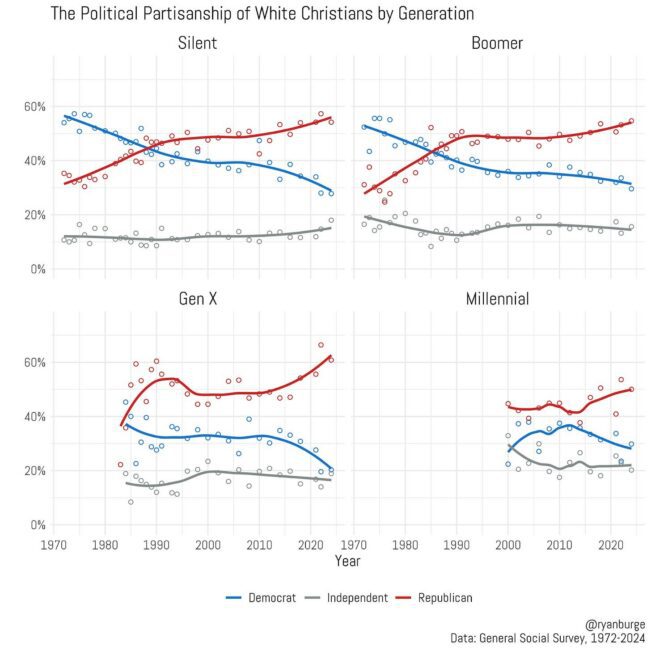
Distinguishing between these possibilities is essential to understanding how white Christianity became aligned with the Republican Party. One way to explore those possibilities is to do a cohort analysis of white Christians over time. Here, I am replicating the prior graph, but this time I am breaking it down into the four most recent generations (excluding Gen Z, for which the available survey years are limited).