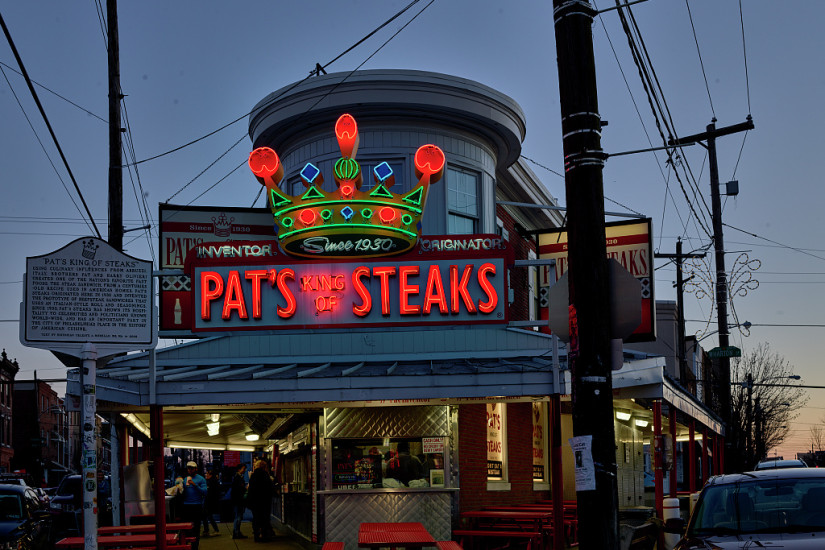
Pat’s King of Steaks juts out on a triangle corner in South Philadelphia’s East Passyunk neighborhood, across the street from rival restaurant Geno’s Steaks. Both local culinary institutions claim credit for popularizing or perfecting one of the nation’s most famous sandwiches: the Philly cheesesteak. But only Pat’s has the distinction of a historical marker.
“When people think of Philadelphia, they think cheesesteak, the Rocky statue and maybe that bell with the crack in it,” jokes Pat’s owner, Frank Olivieri. While he has deep respect for the city’s oft-heralded 18th- and 19th-century history, Olivieri feels more recent events in Philadelphia, particularly food history, often get short shrift. “A lot of it gets overlooked,” he says. “Just because [other things] happened in the 1700s doesn’t mean something that happened in 1930”—the year Olivieri’s great-uncle Pat Olivieri invented the cheesesteak—“isn’t historic.”
The Pat’s historical marker was installed in 2008, proudly placing the cheesesteak within American and global culinary history. Cast in aluminum with raised black lettering on a light gray background, it follows the instantly recognizable sign-on-a-stick form shared by thousands of historical markers across the United States. Yet one characteristic sets this marker apart: Olivieri put it up himself, enlisting historian Celeste A. Morello to write the text. Erected without involvement from state or local historical organizations, the sign speaks to the chaotic system of overlapping interests surrounding such markers. As Olivieri says, “I’m not going to stand around and wait for someone else to pat me on the back.”
When it comes to historical markers, the hidden truth is this: In any given state, as many as ten or more entities could be putting up signs at the same time. Decades ago, states typically had just one official marker program. Now, many more state, local and private entities, each with their own policies and processes, regularly erect markers. The bizarre reality is that anyone with a few thousand dollars and a place to put a marker can get one saying whatever they want. Given broad similarities in design, it’s difficult to tell who’s responsible for the more than 185,000 markers recorded in the Historical Markers Database—a volunteer-run online catalog that’s arguably the most comprehensive resource of its kind—without a close inspection.
As the director of research at the American Association for State and Local History (AASLH), I’ve found myself wondering who exactly historical markers benefit. Why do we put them up? And, in an age when so much information is available on our cellphones, why should anyone care about them?