Person

Brandon M. Terry

Related Excerpts

The Dig
Podcast
The Dig

MLK, Political Philosopher.

Martin Luther King, Jr. is often remembered for his soaring oratory. But the commonplace emphasis on his rhetoric in place of his ideas too often allows enemies of King's agenda to domesticate him or, worse, to weaponize his taken-out-of-context words to bolster the very forces of racism and oppression that King had struggled to defeat. This episode discusses King’s views on nonviolence, the Black Power movement, gender, hope, political economy, Beloved Community, and more.
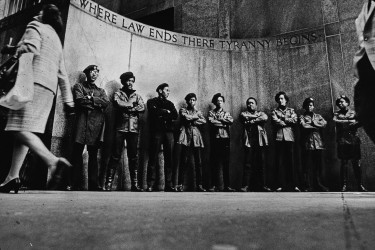
Black Panthers stand with arms folded during a demonstration in New York City, on April 11, 1969.

The Long Civil Rights Movement

The traditional narrative of an integrationist vs. Black Power binary fades in the context of global movements for self-determination.
MLK giving his Vietnam speech

“Somehow This Madness Must Cease.”

Revisiting MLK Jr.’s sermon against the Vietnam War.

MLK: What We Lost

50 years after King's death, his image has been transformed and stripped of its radicalism.
Children learning about Thanksgiving, with model log cabin on table, Whittier Primary School, Hampton, Virginia circa 1900.

Fugitive Pedagogy

Jarvis Givens rediscovers the underground history of black schooling.
A mostly African American audience listens to a speaker at the 5th Pan-African Conference, 1945

The New Black Internationalism

The Movement for Black Lives has developed an incipient internationalist language and vision, with the potential to remap America’s place in the world.

Martin Luther King Jr. and the Meaning of Emancipation

He was a revolutionary, if one committed to nonviolence. But nonviolence does not exhaust his philosophy.