Menu
Excerpts
Exhibits
Collections
Originals
Podcasts
Categories
Map
Search
Person
Thomas Paine
Feb. 9, 1737—June 8, 1809
Book
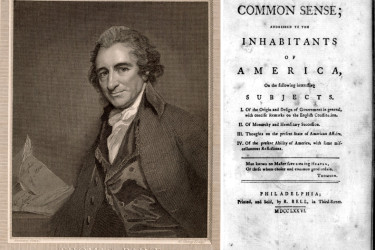
Common Sense
Thomas Paine
1776
View on Map
Related Works
Book
The Church of Saint Thomas Paine
: A Religious History of American Secularism
Leigh Eric Schmidt
2021
Related Excerpts
Load More
Viewing 1–20 of 86
Tom Paine’s Fight
The pamphleteer’s insistence that America live up to its revolutionary vows still rings true 250 years later.
by
John Nichols
via
The Nation
This publication restricts nonsubscriber access to some or all of its articles.
on
June 9, 2026
Thomas Paine Helped Start America. In the Trump Era, He's Under Fire
The debate over Paine's legacy today is a proxy for a much larger debate over whose vision gets to govern.
by
Jack Jenkins
via
Religion News Service
on
May 13, 2026
Thomas Paine, Common Sense and a Plan for America
The constitutional ideas in Thomas Paine's famous pamphlet.
by
Jett Conner
via
Journal of the American Revolution
on
November 20, 2025
Secrets of a Radical Duke
How a lost copy of the Declaration of Independence unlocked a historical mystery.
by
Danielle Allen
via
The Atlantic
This publication restricts nonsubscriber access to some or all of its articles.
on
October 9, 2025
Inventing the American Revolution: On Thomas Paine’s Guide to Fighting Dictatorship
“How are free people supposed to stay free? One short answer: don’t trust anyone over thirty.”
by
Matthew Redmond
via
Literary Hub
on
August 13, 2025
Tom Paine’s Bridge
We do not often think of Paine as a revolutionary inventor. But in a very real sense, that is what he believed himself to be.
by
Edward G. Gray
via
Commonplace
on
April 16, 2020
America and Other Fictions: On Radical Faith and Post-Religion
Thomas Paine, the most radical of American revolutionaries, perhaps most fully understood the millennial potential of the new Republic.
by
Ed Simon
via
The Revealer
on
December 20, 2018
Capitol Hill Needs Thomas Paine Memorial
Why is there still no memorial to Paine, the immigrant whose writing galvanized the American Revolution?
by
Jeff Biggers
via
The Hill
on
October 21, 2018
partner
Declaring “Revolution”
Even after the fighting started, it took years before American Patriots started calling their cause a “revolution.”
by
Robert A. Gross
via
HNN
on
June 30, 2026
The American Revolution Wasn’t the Main Event
Americans have long imagined that they set off a global age of revolt. Seen within the era’s wider wars of empire, the story looks rather different.
by
Daniel Immerwahr
via
The New Yorker
This publication restricts nonsubscriber access to some or all of its articles.
on
May 4, 2026
Give Me Independence: On 1776, the Pivotal Year For What Would Become America
Why 1776 became the year Americans declared themselves an independent nation.
by
Edward J. Larson
via
Literary Hub
on
December 5, 2025
The Loyalist Who Gave Birth to His Nightmare
Thomas Paine nearly died quarantined off in Philadelphia in 1774. Then a Loyalist doctor nursed him back to health.
by
Richard B. Moriarty
via
Journal of the American Revolution
on
September 9, 2025
Taking Up the American Revolution’s Egalitarian Legacy
Despite its failures and limitations, the American Revolution unleashed popular aspirations to throw off tyranny of all kinds.
by
Taylor Clark
via
Jacobin
This publication restricts nonsubscriber access to some or all of its articles.
on
July 4, 2024
How Samuel Adams Helped Ferment a Revolution
A virtuoso of the eighteenth-century version of viral memes and fake news, he had a sense of political theatre that helped create a radical new reality.
by
Adam Gopnik
via
The New Yorker
This publication restricts nonsubscriber access to some or all of its articles.
on
October 24, 2022
The Changing Same of U.S. History
Like the 1619 Project, two new books on the Constitution reflect a vigorous debate about what has changed in the American past—and what hasn’t.
by
David Waldstreicher
via
Boston Review
on
November 10, 2021
The Failure of American Secularism
How the secular movement underestimated the endurance of religion.
by
Chris Lehmann
via
The New Republic
This publication restricts nonsubscriber access to some or all of its articles.
on
November 3, 2021
Contagious Constitutions
In her new book, Colley shows how written constitutions developed both as a way to further justify rulers and to turn rebellions into legitimate governments.
by
Jenny Uglow
via
New York Review of Books
This publication restricts nonsubscriber access to some or all of its articles.
on
June 3, 2021
Our Chief Danger
The story of the democratic movements that the framers of the U.S. Constitution feared and sought to suppress.
by
William Hogeland
via
Lapham’s Quarterly
on
September 1, 2020
The Remembered Past
On the beginnings of our stories—and the history of who owns them.
by
Lewis H. Lapham
via
Lapham’s Quarterly
on
December 14, 2019
AOC and the American Founding
The problem with progressive intellectuals looking to the nation's founders for progressive models.
by
William Hogeland
via
William Hogeland blog
on
January 30, 2019
Previous
Page
1
of 5
Next