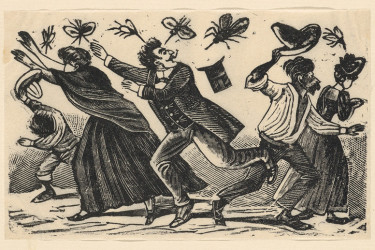
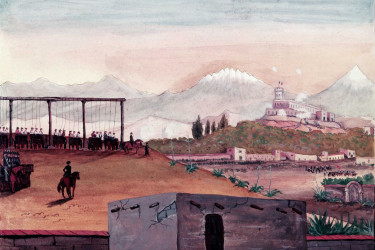
In the Northern Sonora town of Caborca, on April 7, 1857, Henry Alexander Crabb stood with his hands tied above his head to a post in front of him, his back turned to a firing squad. Moments later some 100 bullets riddled his body. A Mexican severed Crabb’s head from his body, allowing the crowd to jeer at it. Afterwards the head was preserved in mescal. The bodies of Crabb’s men, who had also been executed that day, lay unburied and eaten by birds and hogs outside the cemetery walls at Caborca. Four other Americans, who had remained on the American side of the border, were executed a few days later when Mexican troops crossed the international boundary to find them. Thus the San Diego Herald reported the tragic end of Californian’s last and most notorious filibustering expedition to Mexico. It was from the San Diego Herald that other California newspapers first learned of Crabb’s fate. The Herald provided the detailed reports used by the state’s other important newspapers in the first few weeks after Crabb’s execution. These reports came from travelers who drifted into San Diego, the closest California town to the Mexican border.
To San Diegans and other Californians, the outcome of Crabb’s expedition was shocking. Perhaps Mexicans had reached a limit of endurance. In the preceding two decades Mexico had lost her northern territory from Texas to California, some half of her land mass. Since that time Mexicans had struggled to bring about internal order and stability. Making this very difficult were young, restless Americans, frustrated in their professions and attempts to become rich, and infected with the spirit of “Manifest Destiny” — the belief that they had a right and a duty to extend their country’s borders to its “natural frontiers.” The decade of the 1850s saw many Californians leaving the gold fields empty-handed and looking for other areas to make their fortunes. Since 1851 American freebooters had crossed into Mexico under the pretext of “freeing” Mexicans from their own government. The Americans had hopes of colonizing land rich in mineral wealth. Filibusters such as Joseph C. Morehead, Count Gaston de Raousset-Boulbon, Charles de Pindray, and William Walker had attempted to seize portions of Sonora or Lower California during the first half of the decade. Then, in 1857, Henry A. Crabb, a former California state senator and Whig party leader who was unsuccessful in his 1854 reelection bid to the state legislature, made his fatal filibustering attempt.