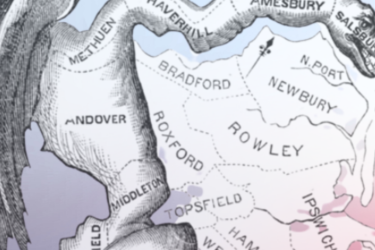
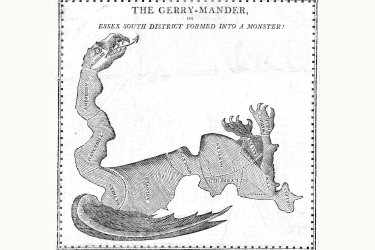
Long and thin, the redrawn state senate district in Massachusetts stretched from near Boston to the New Hampshire border, where it hooked east along the Merrimack River to the coast. It sliced up Essex County, a political stronghold for the Federalist Party – all by design of its ascendant political rival, the Democratic-Republicans. It worked: the freakishly shaped district elected three Democratic-Republicans that year, 1812, breaking up the county’s previous delegation of five Federalist senators.
It wasn’t the first time in American history that political machinations were behind the drawing of district boundaries, but it would soon become the most famous.
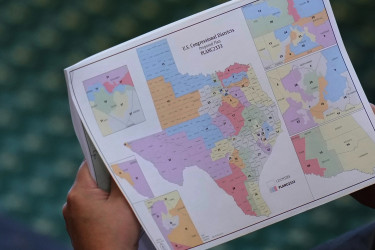
Gerrymandering, the politicians’ practice of drawing district lines to favor their party and expand their power, is nearly as old as the republic itself. Today, we see it in Ohio’s “Lake Erie Monster” and Pennsylvania’s “Goofy Kicking Donald Duck.” But where did the name come from, and who was the namesake for the much-maligned process?
Elbridge Gerry, the governor who signed the bill creating the misshapen Massachusetts district, was a Founding Father: signer of the Declaration of Independence, reluctant framer of the Constitution, congressman, diplomat, and the fifth vice-president. Well-known in his day, Gerry was a wild-eyed eccentric and an awkward speaker, a trusted confidant of John Adams and a deep (if peculiar) thinker. He could also be a dyspeptic hothead—a trait that got the better of him when he signed the infamous redistricting bill.
A merchant’s son from the port town of Marblehead, Massachusetts, Gerry had wanted a different kind of fame—the immortality that comes with founding a nation. Elected to the Continental Congress in December 1775, Gerry lobbied his fellow delegates to declare independence from Great Britain. “If every Man here was a Gerry,” John Adams wrote in July 1776, “the Liberties of America would be safe against the Gates of Earth and Hell.”
But Gerry was also a “a nervous, birdlike little person,” wrote biographer George Athan Billias in his 1976 book, Elbridge Gerry: Founding Father and Republican Statesman. He stammered and had an odd habit of “contracting and expanding the muscles of his eye.” Colleagues respected Gerry’s intelligence, gentlemanliness, attention to detail, and hard work, but his maverick political views and personality sometimes hurt his judgment. According to Adams, he had an “obstinacy that will risk great things to secure small ones.”