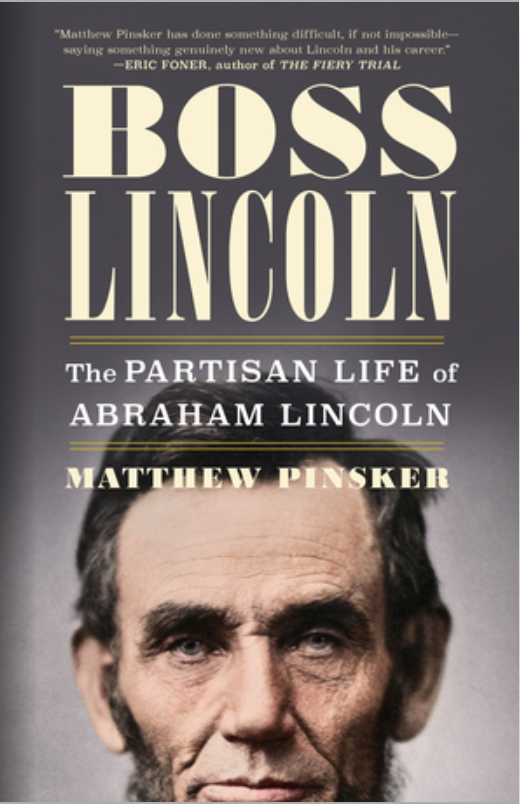
Boss Lincoln echoes Pinsker’s first book, Lincoln’s Sanctuary: Abraham Lincoln and the Soldiers’ Home, in earning praise for finding new angles. A study of Lincoln as a hard-nosed party leader – as a Whig in the 1840s, encompassing his term in Congress; in the next decade, as the Republican party formed against slavery; as wartime president – Boss Lincoln was years in the making.
“My boys teased me that the book has its own bar mitzvah,” Pinsker said. “But I’ve been working on this project on and off since I was a college student, a research assistant to [Lincoln biographer] David Donald, and I’ve always been working on Lincoln as a partisan and a politician. I knew there was a book in it, it just took me a while to get to this version.
“The key to writing new things is to find new evidence. And the not-so-hidden mystery of Lincoln is that every year we find a few new documents hidden in some archive or attic trunk. Each of them individually is not earthshaking, but over the last couple of decades there have been dozens of these private and confidential communications that he’s written that have turned up, that reveal a different side of him.
“That’s the kind of foundation of the material I use and then the rest comes from digitizing so many sources. I live in this digital era. Historians from the past had to only work through archives and printed sources, and so it was harder to make connections between the fragments. It’s much easier for people in my era to do it, and that creates a richer set of opportunities for understanding behind-the-scenes politics.”
Much of Boss Lincoln deals with such strategising, planning and dealing, the offer and counter-offer of politics. Tense moments happen in smokey rooms – though Pinsker contends that one famous instance of Lincoln’s political genius, the passage of the 13th amendment that abolished slavery, has been overplayed in popular culture, not least by Steven Spielberg in Lincoln, his Oscar-winning movie from 2013.
“It shows Lincoln after all of the hard decisions had been made and won,” Pinsker said. “By that point [January 1865] they knew they could obtain a 13th amendment … they didn’t need to bribe people to support it. The movie suggests Lincoln condoned bribery. That’s not Boss Lincoln.”