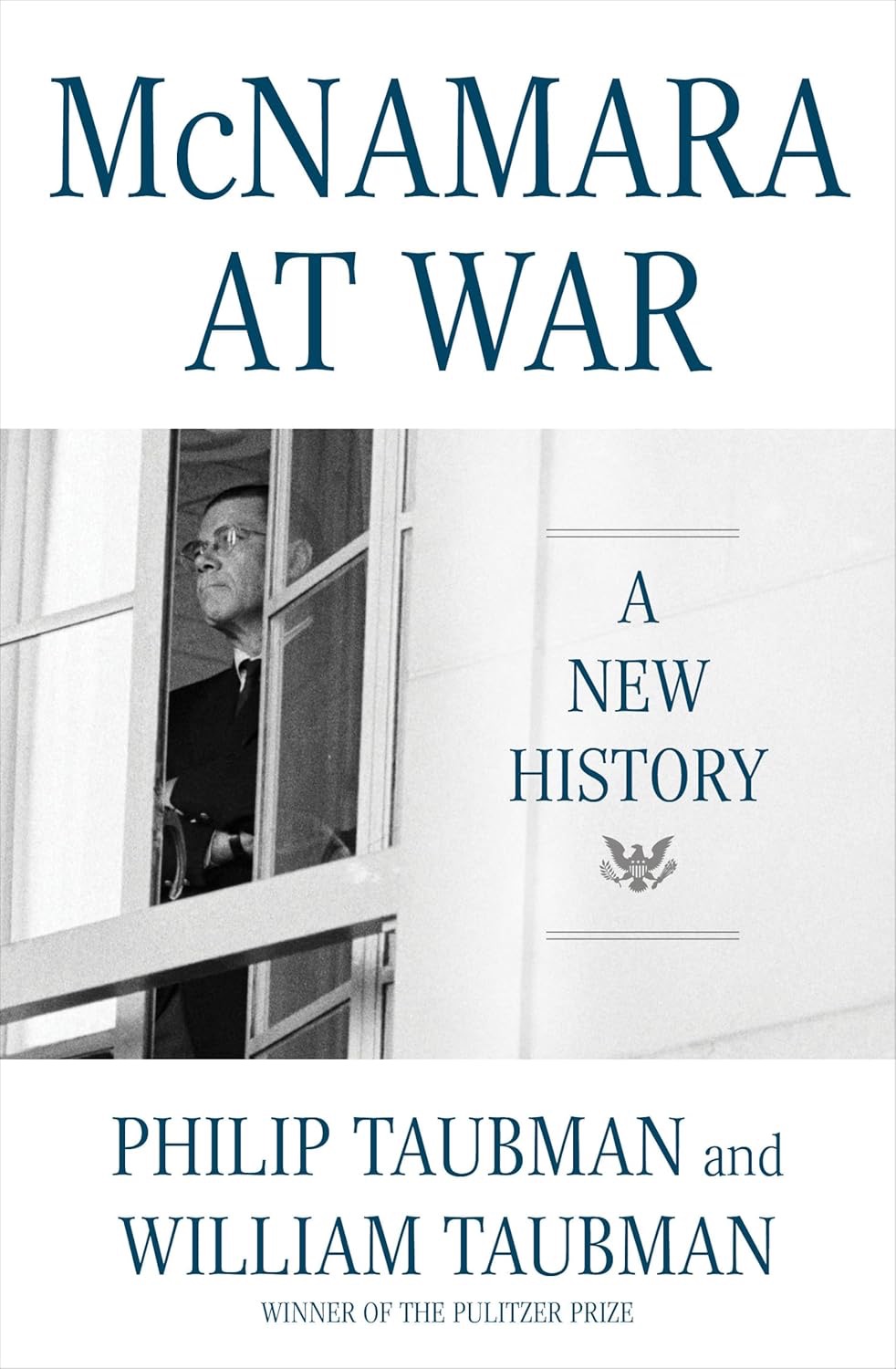
The Taubmans recount in detail the consequential events of 1965. As a reelected Johnson plowed toward escalation in Vietnam, McNamara became his fiercest partner. He savaged dissent, including a memo from Under Secretary of State George Ball warning presciently about the futility of it all, which McNamara countered (in Ball’s account) with “a pyrotechnic display of facts and statistics to prove that I had overstated the difficulties we were now encountering.” In February the decision was made to commence bombing North Vietnam, and in July to send American ground troops. By the end of the year, McNamara knew the policy was doomed. Each escalation was matched by a determined response. Rather than breaking North Vietnamese will, indiscriminate bombing hardened it. The corrupt South Vietnamese government had no legitimacy. The US military had no answers other than demanding more resources.
Yet he stayed on for a jumble of reasons. He was credulous about those arguments of credibility: that Vietnam could be a domino that led all of Asia to fall under Soviet dominion. He saw himself as a brake on the hawkish generals who had intentions that could have led to war with the Chinese. Time and again he used his powerful mind to rationalize staying rather than taking a moral stance and leaving. Perhaps above all, he had a narrow conception of loyalty. “He thought his paramount duty as defense secretary was to serve the president loyally,” the Taubmans write, “contrary to the oath that he and all other cabinet members took that made clear that their primary obligation was to uphold and defend the Constitution of the United States.”
Serving the president, of course, also preserved McNamara’s power and status. For more than two years, he was an accomplice in Johnson’s efforts to mislead the public about the actual cost of the war. In 1965 he declared that the United States had “stopped losing the war.” In 1966 he was “cautiously optimistic.” This master of control accounting told the skeptical journalist Neil Sheehan that “every quantitative measurement we have shows that we’re winning.”
By February 1968 McNamara was out, on the verge of a breakdown, not sure whether he’d resigned or been fired. “There weren’t any answers,” he later lamented. But there were answers all along. American officials had just refused to see them.